




Last updated: November 3, 2026
Web Design ROI for Small Businesses: A Complete 2026 Guide
Your website isn’t just a digital storefront. It’s an important business asset that can help attract customers, generate leads, and support long-term growth. For small business owners, understanding web design ROI means knowing whether their website investment is delivering measurable business value.
In 2026, businesses can improve website performance by measuring conversions, understanding customer behavior, and making informed design improvements.
This guide reveals exactly how to calculate your website investment return, what to expect at different budget levels, and proven strategies to maximize every dollar spent on design and development.

What Is Web Design ROI and Why It Matters for Small Business Growth
Web design return on investment measures the financial gain or loss generated by your website relative to the amount invested in its creation and maintenance. Unlike vanity metrics like page views, real ROI ties design improvements directly to revenue: new customers, increased order value, or reduced operational costs through automation.
For small businesses, a professional website represents an investment in online visibility, customer experience, and lead generation. Website costs vary depending on the project’s scope, features, design requirements, and ongoing maintenance needs. A well-planned website can support business growth by making it easier for potential customers to find information and take action.
The core question isn’t “Can we afford a better website?” but rather “Can we afford not to optimize our digital presence?” A poorly designed website can make it harder for potential customers to understand your services, navigate your pages, and take action. Improving the user experience can help businesses create stronger opportunities for customer engagement and conversions.
Understanding Custom Web Design Cost for Small Business Owners
Understanding the cost of custom web design helps small business owners plan their budgets, prioritize essential features, and choose solutions that support their business goals.
Investment size directly impacts your ROI potential. To understand what you’re paying for, it’s helpful to review illustrative budget ranges and the deliverables that may be included at different investment levels.
Budget Breakdown by Investment Level
Budget tier ($3,000–$8,000): This range may cover template-based designs with customization, basic SEO setup, and standard mobile optimization. Available features, revision rounds, and project timelines depend on the provider and project requirements.
Mid-range tier ($8,000–$15,000): Projects in this range may include semi-custom design, payment processing, CRM integration, conversion-focused layouts, and content strategy. The final scope and timeline depend on the complexity of the website.
Premium tier ($15,000–$35,000+): Larger projects may involve fully custom design, advanced integrations, specialized functionality, comprehensive SEO architecture, and ongoing performance optimization. These services require careful planning and vary in cost and delivery time.
These figures are illustrative planning ranges, not fixed industry pricing. Actual quotes depend on the website’s scope, functionality, content, and service provider.
Website Design Impact on Revenue for Small Businesses
The relationship between website design and business performance can be evaluated through user behavior, engagement, and conversion data. A professional website design can help establish credibility and build trust with potential customers. Clear messaging, consistent branding, and easy navigation make it easier for visitors to understand your business.
Website redesigns can create opportunities for improvement in several areas, depending on the business and its starting performance:
- Improved conversion opportunities through clearer calls to action
- Better user engagement through easier navigation
- Improved mobile experience through responsive layouts
- More opportunities for repeat visits through useful content
Actual results vary depending on traffic quality, business type, and ongoing optimization.

ROI by Business Type
Service businesses: Website ROI often focuses on generating qualified inquiries, improving contact form submissions, and converting visitors into paying customers.
E-commerce businesses: ROI can be measured through online orders, conversion rate, average order value, and repeat purchases.
B2B SaaS and software: Website performance can be evaluated through demo requests, trial registrations, lead quality, and customer acquisition.
The most useful metrics depend on each business model and its goals.
Calculating Your Expected Web Design Investment Return
To estimate your web design investment return, identify three core metrics: current monthly website visitors, lead conversion rate, and lead-to-customer close rate. These measurements provide a starting point for evaluating how website improvements may contribute to business revenue.
The ROI Calculation Formula
Step 1: Calculate current monthly customers
Monthly visitors × Lead conversion rate × Lead-to-customer close rate = Monthly customers
Step 2: Calculate current monthly website revenue
Monthly customers × Average project value = Current monthly website revenue
Step 3: Project improved monthly revenue
Monthly visitors × Target lead conversion rate × Lead-to-customer close rate × Average project value = Projected monthly website revenue
Step 4: Calculate incremental monthly revenue
Projected monthly revenue − Current monthly revenue = Monthly incremental revenue
Step 5: Estimate the payback period
Website investment ÷ Monthly incremental profit = Estimated months to break even
Step 6: Calculate website ROI
ROI (%) = [(Net Financial Gain − Website Investment) ÷ Website Investment] × 100
Net Financial Gain is the additional financial return generated during the measurement period after deducting relevant operating and ongoing costs, but before subtracting the initial website investment. Use consistent figures and include all relevant website-related expenses when evaluating the actual return.
Note: Use incremental profit or contribution after relevant costs, not gross revenue, when estimating the actual payback period.
Example: A service business receives 1,000 monthly website visitors and converts 3% into leads, generating 30 leads. If 20% of those leads become paying customers, the business gains 6 customers. At an average project value of $2,500, this represents $15,000 in potential monthly revenue.
If a website redesign increases the lead conversion rate from 3% to 4.2%, the business would generate 42 leads instead of 30. At the same 20% close rate, this represents an expected 8.4 customers and approximately $21,000 in projected monthly revenue. The figure of 8.4 customers represents an expected statistical average; actual customer counts will be whole numbers and may vary.
Compared with the original $15,000, this represents an estimated $6,000 increase in monthly revenue before accounting for project costs and other expenses. These figures are illustrative estimates, not guaranteed results.
Key Factors That Maximize Web Design ROI
Not all websites deliver equal returns. The difference between a website that supports business growth and one that delivers limited results often comes down to strategic implementation of user experience, search engine optimization, and conversion-focused design principles.
Design and User Experience Excellence
Friction-free navigation, fast load times, mobile optimization, and intuitive call-to-action placement reduce bounce rates and increase engagement. Web design trends for 2026 emphasize conversion-focused techniques like progressive disclosure, social proof integration, and personalized user paths.
SEO Architecture Built Into Design
A beautifully designed site that ranks poorly generates few visitors. Ensuring your designer and developer implement SEO best practices during web design helps avoid technical and structural issues that can limit search visibility and helps your website attract qualified organic traffic.
Clear Value Proposition and Messaging
Visitors should understand what you offer and why they should care. Unclear messaging or weak positioning undermines even exceptional design. Professional copywriting paired with visual hierarchy dramatically improves conversions.
Conversion Rate Optimization Built Into Strategy
Design is a foundation, but conversion rate optimization mistakes can undermine website performance. Common issues include poorly designed forms, unclear calls to action, and missing trust indicators. Addressing these elements during the design process can help create a smoother customer journey.
Custom Web Design vs. Templates: ROI Comparison
Should you invest in custom design or use templates? The ROI answer depends on your business model and scale.
Template-based design ($3,000–$8,000): Lower initial investment, faster launch, and fewer customization options. Best for new businesses validating their services or those with tight budgets and simple website requirements.
Custom design ($15,000–$35,000+): Higher initial cost, tailored brand expression, and greater flexibility for customization. Best for established businesses with clear competitive differentiation, higher average customer value, or complex sales processes.
Understanding the real cost of DIY and template design for small businesses reveals that underinvestment often costs more in lost revenue than a proper design investment upfront.
Measuring and Tracking Web Design ROI Metrics
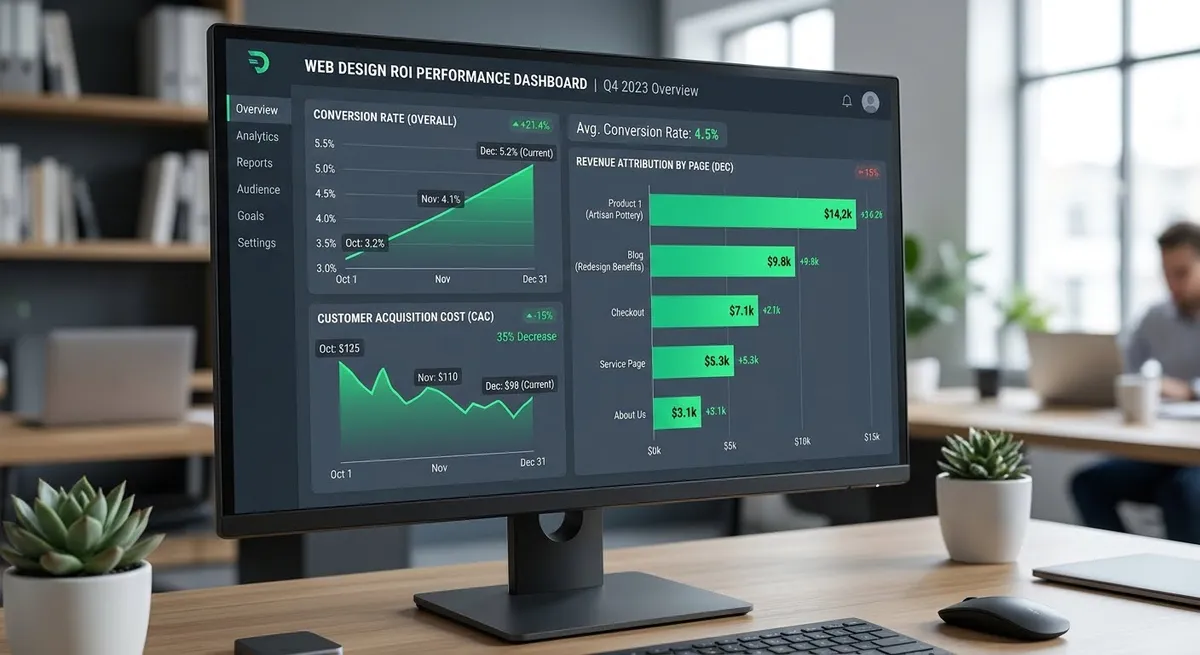
Assumptions mean nothing without measurement. Establish baseline metrics before launch, then track these KPIs monthly:
- Organic traffic: Visits from search results (indicates SEO value)
- Conversion rate: Visitors converting to leads/customers
- Cost per acquisition: Include relevant marketing and sales costs, not just the website design investment, when calculating the cost of acquiring a new customer.
- Customer lifetime value: Total revenue generated by website-sourced customers
- Average session duration: User engagement indicator
- Bounce rate: The percentage of sessions that are not engaged under GA4’s measurement rules. Interpret this metric alongside engagement and conversion data.
- Page load speed: Core Web Vital metric affecting both UX and rankings
- Lead quality score: Percentage of leads closing vs. total leads generated
Without reliable data, it is difficult to evaluate website performance. Consistent tracking helps businesses identify opportunities, make informed improvements, and measure progress over time.
When Should a Small Business Expect Web Design ROI?
The time required to recover a website investment depends on project costs, website traffic, conversion improvements, profit margins, and ongoing expenses. Some businesses may see improvements in lead generation or customer inquiries shortly after launch, while measurable financial returns may take longer.
Rather than relying on a fixed timeline, establish a baseline before launching the redesigned website. Track qualified leads, conversion rates, customer acquisition costs, and revenue generated from website visitors. Review these metrics monthly and compare results against the original performance.
A practical payback estimate should use incremental profit or contribution after relevant expenses, not additional revenue alone. Regular monitoring helps business owners determine whether their website investment is producing meaningful financial value.
Common ROI Mistakes Small Business Owners Make
Mistake 1: Underinvesting because of budget constraints. Choosing a website solution based only on the lowest upfront price can lead to limitations in functionality, user experience, or future scalability. Compare options based on your business needs, essential features, expected maintenance, and available budget.
Mistake 2: Setting unrealistic timelines. Expecting immediate returns after launching a website can lead to unrealistic expectations. Website performance should be evaluated over time using reliable traffic, conversion, and revenue data. Set realistic goals and allow room for testing and ongoing optimization.
Mistake 3: Ignoring post-launch optimization. The design launch is the beginning, not the end. Continuous A/B testing, content updates, and technical optimization compound ROI over years.
Mistake 4: Prioritizing aesthetics over conversion. A beautiful site that doesn’t convert is expensive wall art. Every design decision must balance beauty with purpose and measurable outcomes.
Investing in the Right Web Design for Your Small Business
Your web design investment should reflect your business goals, current scale, and growth ambitions. Depending on the project’s scope and requirements, small businesses may consider a range of custom or semi-custom website solutions. The right investment is one that balances available resources, essential features, and long-term business objectives.
Before selecting a designer or agency, clarify your ROI expectations: How many new customers do you need monthly to justify the investment? What’s your average customer value? How long is your decision cycle? Use these answers to vet partners who understand ROI-focused design rather than agencies focused solely on portfolios.
Successful small businesses view web design as a strategic investment that can create ongoing value through continuous optimization, useful content, and improvements in search visibility.
Conclusion: Your Web Design ROI Starts Today
Web design ROI for small businesses is measurable through leads, customer engagement, conversions, and revenue. A well-planned website can support business goals by improving user experience, making information easier to access, and creating clearer paths for potential customers.
Successful businesses approach web design strategically. They invest according to their needs, monitor website performance, and make improvements based on reliable data. Measuring results over time helps business owners understand how their website contributes to growth.
Ready to improve your website’s performance? Contact Particular Angles to discuss your web design goals, evaluate your current website, and explore strategies that support your business growth.
Particular Angles helps small businesses strengthen their online presence through conversion-focused web design, technical SEO, and strategic digital marketing. Our approach focuses on creating websites that support business goals, improve user experience, and generate opportunities for growth.