




Last updated: October 27, 2026
Small Business Website Design Impact on Revenue
Your website is often the first impression potential customers have of your business. Understanding the small business website design impact on revenue can help you improve conversions, build customer trust, and generate more leads. This guide explains how website design can influence revenue, customer trust, and conversions, with practical strategies small businesses can use to improve their websites.
The question isn’t whether design matters; it’s how much revenue you may be leaving on the table. A well-designed website can make it easier for visitors to understand your services, navigate key pages, and take action. Results depend on your audience, industry, and current website performance.
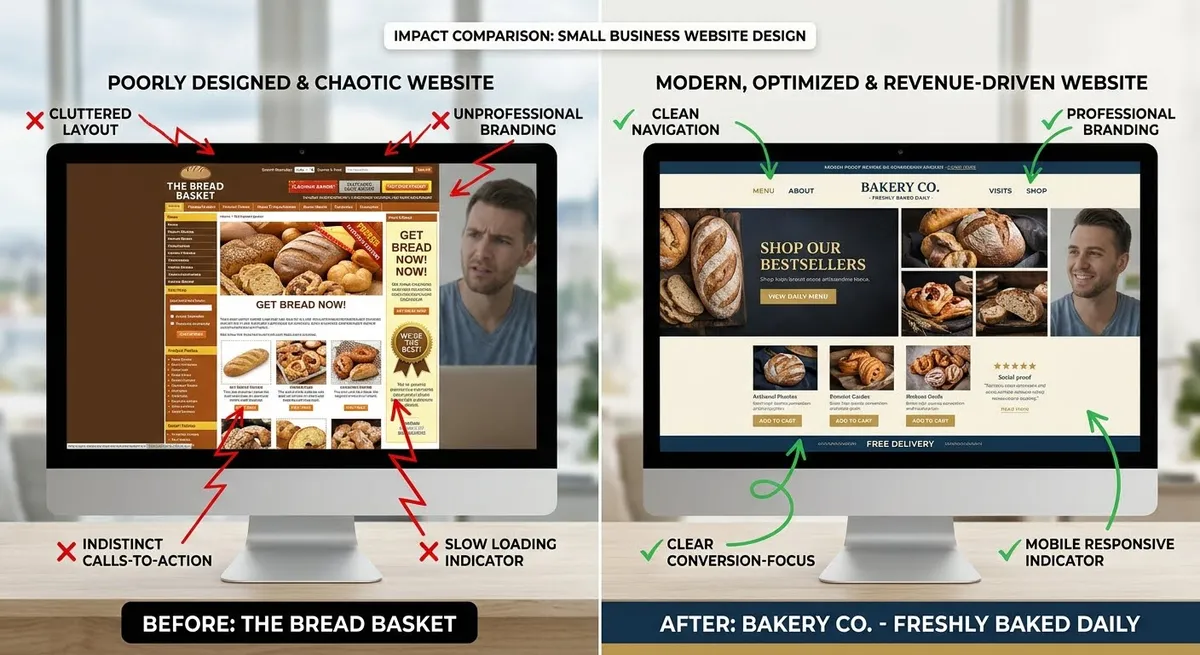
The Business Case: Website Design’s Direct Revenue Impact
Website design can influence how visitors perceive your business and whether they take action. A clear layout, useful content, and intuitive navigation can help visitors understand your services and find the next step.
The financial impact depends on your website traffic, conversion rate, average order value, and the value of each lead or sale. Track these metrics before and after design changes to estimate the actual return on your investment.
This is why understanding how website design affects business performance matters more now than ever. Whether you’re operating an e-commerce store, service business, or B2B company, your web presence directly influences your bottom line.
How Website Design Influences Conversions
Desktop vs. Mobile Performance
- Mobile optimization is essential for providing a consistent experience across phones, tablets, and desktop computers. Make sure text is readable, navigation is easy to use, and important buttons and forms work well on smaller screens. Monitor page speed, bounce rate, and conversion rate by device to identify opportunities for improvement.
- Mobile-friendly websites and improved page speed can provide a better user experience and may support higher conversion rates. Monitor performance by device to measure actual results.
Trust Signals and Professional Design
Professional design elements aren’t just cosmetic; they can also help improve conversions. Websites featuring customer testimonials, professional photography, and clear security indicators can help build visitor confidence and support purchase decisions.
Small Business Web Design Best Practices for Revenue Growth
Knowing that design impacts revenue is half the battle. The real challenge is implementing the right design strategies. Here are the practices that consistently drive measurable results for small businesses.
1. Implement Crystal-Clear Value Propositions
Visitors should be able to understand what your business offers and why it matters as soon as they land on your homepage. Use a clear headline, concise supporting text, and a prominent next step.
Too many small business websites bury their core message beneath vague industry jargon or generic headlines. Instead, use specific, benefit-driven language. Instead of “Digital Solutions for Your Business,” try “Turn More Website Visitors Into Customers.”
2. Optimize Call-to-Action (CTA) Button Design
High-contrast CTAs can make important actions easier to notice. Use clear, action-oriented language, adequate white space, and strategic placement, then test variations to see what works best for your audience.
Best practices include using action-oriented language (“Get Started,” “Claim Your Free Consultation,” “Schedule a Demo”), maintaining adequate white space around buttons, and placing multiple CTAs strategically throughout your pages.
3. Streamline Navigation Structure
Complex navigation can make it harder for visitors to find what they need. Organize your site with a clear, logical hierarchy and a menu that highlights your most important pages. Consider adding breadcrumb navigation or search functionality when appropriate to help visitors find relevant information.
Use a sticky header when it improves access to key navigation, especially on longer pages. Keep navigation elements easy to use across desktop and mobile devices.

Affordable Custom Web Design ROI: Professional vs. DIY
One critical decision small business owners face: invest in professional custom design or use budget template solutions. Professional custom design can be tailored to your business model, target audience, and conversion goals, while template-based websites may offer a lower-cost starting point. Actual results depend on implementation, usability, and audience needs.
Template sites, while affordable, often look generic and lack the strategic optimization that drives revenue. Template designers can’t optimize for your specific conversion goals, customer journey, or competitive differentiation.
Understanding affordable custom web design ROI starts with comparing the cost of a website against its business results. Consider your initial investment, ongoing maintenance costs, website traffic, lead generation, conversion rate, and the value of each customer. Before redesigning your website, record your current performance as a baseline. After launch, compare the results over time to assess whether the investment is delivering value. A template website may be a suitable starting point for businesses with limited budgets, while custom design can offer more flexibility for specific business goals.
Design Elements That Directly Influence Purchase Decisions
Professional Photography and Imagery
Stock photography is recognizable and often reduces credibility. Investing in professional photography of your team, products, or service delivery builds trust and establishes authenticity. Authentic photos of your team, products, or services can help visitors understand your business and make your website feel more personal.
Testimonials and Social Proof
Customer testimonials are powerful conversion drivers. Placing testimonials strategically throughout your site, especially near CTAs and on service or product pages, can help reassure prospective customers. Track conversions to measure their impact.
Page Load Speed Optimization
The impact of page speed on conversions varies by website and audience. For example, if a website receives 1,000 monthly visitors and its conversion rate changes from 2% to 1.8%, conversions would decrease from 20 to 18 per month. This is an illustrative calculation, not a guaranteed result of slower page speed. Track your website’s speed and conversion data to measure the actual impact.
Local SEO and Website Design Integration
For service-based small businesses, combining effective website design with local SEO creates powerful revenue opportunities. Your site design should support local search visibility by including your service area, local contact information, and locally-relevant content. Implementing local SEO for service businesses requires both technical design and content strategy optimization.
Integrate Google Maps, local reviews, and location-specific landing pages into your design framework. This approach helps you capture high-intent local search traffic and drives foot traffic to physical locations.
Common Website Design Mistakes Killing Your Revenue
Understanding what not to do is as important as knowing best practices for website design. Here are critical design mistakes that directly reduce revenue for small businesses:
- Auto-playing audio or video: Unexpected media can distract visitors and cause them to leave the website. Let users control audio and video playback.
- Outdated design: An outdated website may reduce visitor confidence and make your business appear less competitive. Keep the design current, accessible, and easy to navigate.
- Unclear pricing: Vague or difficult-to-find pricing information can create uncertainty and reduce customer confidence.
- Intrusive pop-ups: Excessive or poorly timed pop-ups can interrupt visitors and make the website harder to use. Display them thoughtfully and provide a clear way to close them.
- Poor form design: Forms with unnecessary fields can discourage visitors from completing them. Ask only for the information needed and keep the process simple.
For deeper analysis of design failures, explore our guide on SEO mistakes in web design that kill rankings and revenue.
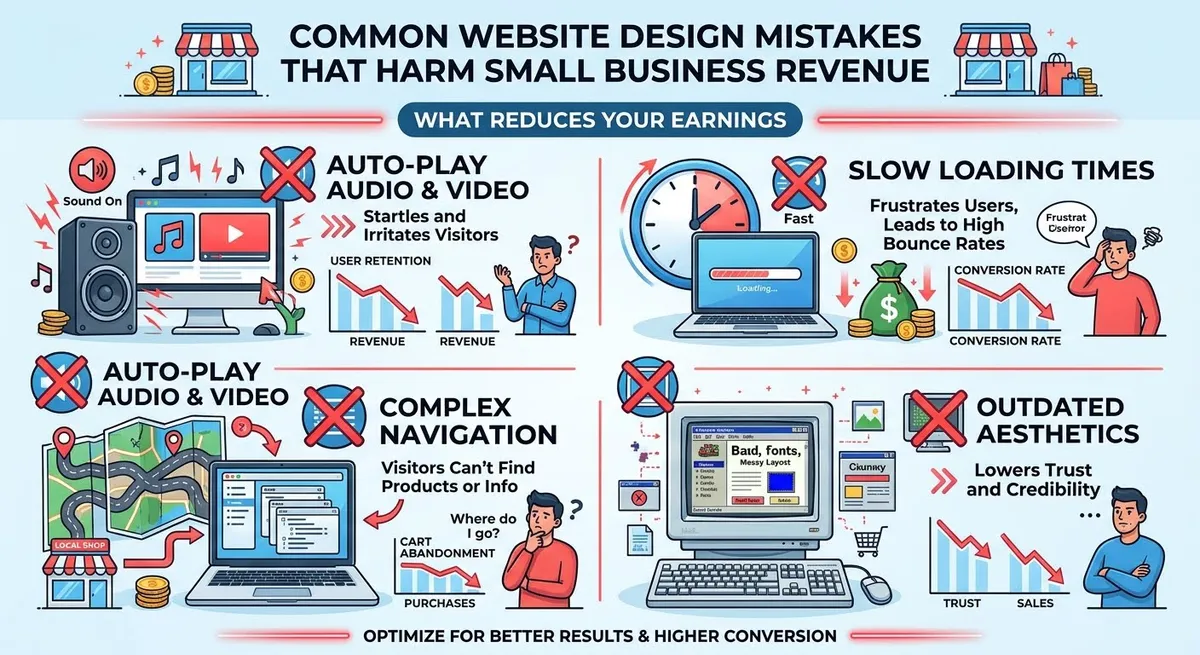
Converting Website Design Investment Into Measurable Revenue
The final piece of this equation is measurement. You can’t improve what you don’t measure. Implement tracking from day one to understand your website’s revenue impact:
Essential Metrics to Track
- Conversion Rate: Percentage of visitors completing desired actions (purchases, lead form submissions, calls)
- Average Order Value: The average revenue generated per transaction. Thoughtful product presentation and relevant upsells may increase this value.
- Customer Lifetime Value: The total value a customer generates throughout their relationship with your business. A better website experience may support customer retention.
- Page Load Speed: The time it takes for a webpage to load. Faster-loading pages can improve user experience and may support conversions.
- Bounce Rate by Device: High bounce rates on mobile indicate design optimization issues
Set baseline metrics before redesigning, then measure performance 30, 60, and 90 days after launch. The time needed to see measurable improvements varies by business, traffic, and implementation.
Building a Conversion-Focused Website Design Strategy
Professional website design isn’t just about creating something beautiful; it’s about creating something strategic. Every design element should serve a business purpose: building trust, guiding visitors toward conversion, or communicating your value proposition.
The best small business website design impact strategies incorporate user experience (UX) research, competitor analysis, and conversion rate optimization principles. When you understand how your specific target audience interacts with websites, you can design experiences that guide them toward purchasing decisions naturally.
This is where professional design agencies differentiate themselves from templates. We optimize for your specific revenue goals, not generic best practices.
Conclusion: Maximize Your Small Business Website Design Impact
The evidence is clear: small business website design impact directly influences your revenue. From conversion rates to customer trust to operational efficiency, your website design either works for you or against you. The businesses winning today are those treating their websites as revenue-generating assets rather than digital brochures.
Whether you’re currently operating an underperforming website or building your presence from scratch, strategic design investments deliver measurable returns. With a clear strategy and ongoing performance monitoring, a well-designed website may improve conversions and contribute to business growth. Actual results vary depending on traffic, audience, and implementation.
Ready to transform your small business website design impact and capture untapped revenue? Contact Particular Angles today for a free consultation. We’ll analyze your current site performance, identify revenue-blocking design issues, and create a strategic roadmap to maximize your web presence. Your competitors aren’t standing still, so take the next step toward improving your website’s performance.
Particular Angles is a web design and digital marketing agency specializing in websites and digital solutions for small businesses and B2B companies. Our approach focuses on user experience, clear messaging, search visibility, and conversion-focused design. We help businesses identify opportunities to improve their online presence and create website experiences aligned with their goals.