


Web Design Case Studies: Examples, Strategies & Lessons From Website Redesigns

A web design case study shows how a website problem was identified, what strategy was used to solve it, and what results followed. Instead of focusing only on how a website looks, effective case studies connect design decisions to measurable business outcomes such as conversions, leads, revenue, engagement, search visibility, or customer satisfaction.

For businesses considering a website redesign, these examples provide a practical way to evaluate what professional web design can achieve. In this article, we’ll examine different web design scenarios from B2B websites and ecommerce product pages to consulting firms and software documentation to explore the challenges, strategies, implementation decisions, and performance metrics that can make a website redesign successful.
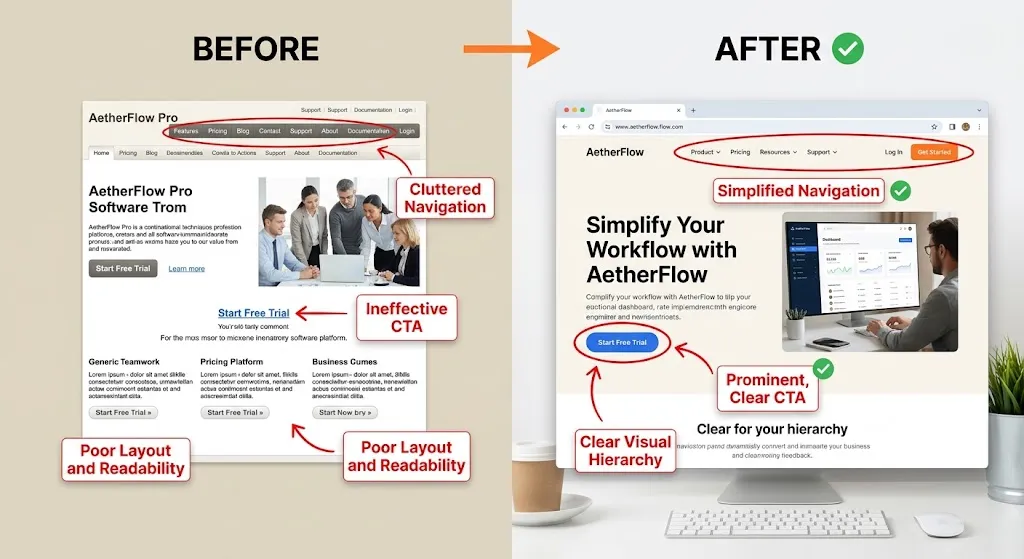
<strong>Website Redesign Before & After</strong> professional desktop website comparison showing improved UX, visual hierarchy, navigation, and CTA.” /></figure>
</p>
<h2>What Makes Strong Web Design Case Studies</h2>
<p>A credible web design case study does more than show pretty screenshots. It documents the problem, the solution, and measurable outcomes. Strong case studies connect website improvements to measurable business outcomes, making documented performance data an important part of evaluating a redesign.</p>
<p>The strongest portfolio examples include:</p>
<ul>
<li><strong>Baseline metrics</strong> — conversion rates, bounce rates, load times before redesign</li>
<li><strong>Strategic approach</strong> — specific design decisions and why they were chosen</li>
<li><strong>Implementation details</strong> — technology stack, responsive design approach, SEO foundation</li>
<li><strong>Post-launch results</strong> — quantifiable improvements in user behavior and business KPIs</li>
<li><strong>Timeline and scope</strong> — project duration, deliverables, team involved</li>
</ul>
<p>Without these elements, a web design case study can become little more than marketing copy. Real case studies tell the story of how problems were identified, solutions were engineered, and results were measured. Reviewing portfolio projects can help businesses evaluate an agency’s approach, design process, technical capabilities, and ability to connect website improvements with business objectives.</p>
<h2>How We Evaluate Web Design Case Studies</h2>
<p>A meaningful web design case study should explain more than what a website looks like after a redesign. It should show how design decisions connect to measurable business objectives. Our approach evaluates each project from the initial problem through implementation and post-launch performance. This approach can also be applied when evaluating website redesign opportunities at Particular Angles: identify the problem first, connect design decisions to business goals, and measure the outcome.</p>
<h3>1. Identify the Starting Problem</h3>
<p>We first identify the main challenges affecting the website. These may include poor conversion rates, confusing navigation, slow performance, outdated design, weak mobile usability, low search visibility, or difficulty generating qualified leads.</p>
<h3>2. Define the Business Objective</h3>
<p>The redesign should have a clear goal. Depending on the business, the objective may be to increase leads, improve ecommerce sales, reduce cart abandonment, increase engagement, improve search visibility, or make it easier for customers to find important information.</p>
<h3>3. Analyze the Existing Website</h3>
<p>Before recommending changes, we evaluate the existing website’s structure, content, navigation, mobile experience, page speed, calls to action, technical implementation, and overall user experience.</p>
<p>At Particular Angles, this analysis helps determine which problems should be addressed first. Rather than treating design, development, UX, and SEO as separate tasks, we look at how they work together to support the website’s goals.</p>
<h3>4. Identify UX, Design, and Technical Issues</h3>
<p>We examine where visitors may encounter friction. This includes unclear messaging, complicated forms, weak calls to action, poor information hierarchy, inconsistent design, technical errors, and mobile usability problems.</p>
<h3>5. Review SEO Opportunities</h3>
<p>SEO is considered as part of the redesign rather than as an afterthought. We review page structure, headings, metadata, internal linking, content organization, <a href=technical SEO, mobile performance, and other factors that can affect search visibility.

6. Implement the Redesign

The solution is then developed around the identified problems and business objectives. Depending on the project, this may include a new visual design, improved navigation, responsive layouts, conversion-focused landing pages, ecommerce improvements, WordPress development, performance optimization, or technical SEO improvements.

7. Compare Before-and-After Performance

When reliable analytics data is available, we compare relevant metrics before and after implementation. These may include conversion rate, lead submissions, ecommerce revenue, engagement, page speed, organic traffic, search visibility, or support requests.

8. Measure the Business Outcome

Finally, we evaluate whether the redesign achieved its intended objective. A successful project isn’t simply one that looks better—it should improve the user experience while contributing to measurable business goals. This outcome-focused approach is also central to how Particular Angles views website improvement. Establishing a clear baseline before a redesign makes it easier to determine whether changes actually improved the areas that matter to the business and where further optimization may be needed.

This methodology helps distinguish a genuine web design case study from a collection of screenshots. By connecting the original problem, strategic decisions, implementation, and measurable outcomes, businesses can better understand the potential value of a professional website redesign.

Website Redesign Before and After: Illustrative Examples

Website redesign before-and-after examples can show how strategic changes to usability, visual hierarchy, content structure, and calls to action can improve the user experience. One common pattern in website redesigns is simplification combined with strategic calls to action. The examples below show how different design strategies can address common website problems.

The following examples are illustrative scenarios based on common website redesign challenges and strategies. They demonstrate how different approaches can address specific UX, conversion, positioning, and information-discovery problems. Where client-specific performance data is confidential or unavailable, the examples focus on strategic lessons rather than unverified results. Actual results vary depending on the business, audience, traffic, baseline performance, and implementation.

Important: The examples below are illustrative scenarios, not claims of verified client results. They demonstrate common website problems, redesign strategies, implementation approaches, and performance metrics. Actual results vary depending on the business, audience, traffic, baseline performance, and implementation.

Example 1: B2B Website Redesign

Illustrative scenario: The following example demonstrates how a typical B2B website redesign might improve messaging, navigation, and conversion paths. It is intended to illustrate the strategy rather than report verified client results.

Challenge: Unclear messaging and complicated navigation

Strategy: Simplify messaging and conversion paths

Implementation: Responsive layouts, reorganized service pages, stronger CTAs

Performance Data: No verified client performance data is available for this illustrative scenario.

Key Takeaway: Clear messaging and navigation can make it easier for visitors to understand a company’s services.

Example 2: Ecommerce Product Page Optimization Scenario

Illustrative scenario: The following example demonstrates how a typical ecommerce redesign might address mobile purchasing friction. It is intended to illustrate the strategy rather than report verified client results.

A common ecommerce redesign scenario involves high mobile cart abandonment despite stronger desktop performance. Product pages may be difficult to use on smaller screens when product images are too small, descriptions require excessive scrolling, or important purchasing actions aren’t persistent.

Scenario at a Glance

Challenge: High mobile cart abandonment and poor mobile product-page experience

Strategy: Adopt a mobile-first product-page design focused on reducing friction

Implementation: Larger product images, sticky add-to-cart button, collapsible specifications, and trust signals

Performance Data: No verified client performance data is available for this illustrative scenario.

The Strategy

The redesign approach included:

  • Mobile-first image gallery with zoom capability
  • Sticky add-to-cart button fixed to the viewport bottom
  • Condensed specifications in collapsible sections
  • Trust signals, including reviews and return policy, above the fold

Key Takeaway: The strongest ecommerce redesigns don’t simply make product pages look better. They remove friction from the purchasing process and make important information and actions easier to access.

<span style="color: rgb(31, 31, 31); background-color: rgb(240, 244, 249);">Mobile Ecommerce Product Page — realistic smartphone mockup with product imagery, reviews, trust signals, specifications, and sticky Add to Cart.</span>” /></figure>
</p>
<h2>B2B Website Design Examples: Illustrative Scenarios and Lessons</h2>
<p>B2B website design examples reveal different success metrics than ecommerce. While ecommerce focuses on immediate purchase decisions, B2B sites must build trust, demonstrate expertise, and capture qualified leads through extended buyer journeys.</p>
<h3>Example 3: Management Consulting Firm Repositioning</h3>
<p><strong>Illustrative scenario:</strong> The following example demonstrates how a typical consulting website redesign might improve positioning, authority, and lead quality. It is intended to illustrate the strategy rather than report verified client results.</p>
<p><strong>Challenge:</strong> Website positioned the company as a generalist</p>
<p><strong>Strategy:</strong> Reposition around financial-services expertise</p>
<p><strong>Implementation:</strong> Industry-specific messaging, case studies, thought leadership, testimonials</p>
<p><strong>Performance Data:</strong> No verified client performance data is available for this illustrative scenario.</p>
<p><strong>Key Takeaway:</strong> Website design can support positioning and lead quality, not just visual improvements.</p>
<h3>Example 4: Enterprise Software Company User Documentation Redesign</h3>
<p><strong>Illustrative scenario:</strong> The following example demonstrates how a typical software documentation redesign might improve information discovery and customer self-service. It is intended to illustrate the strategy rather than report verified client results.</p>
<p><strong>Challenge:</strong> Customers couldn’t find information and relied heavily on support</p>
<p><strong>Strategy:</strong> Improve information discovery and self-service</p>
<p><strong>Implementation:</strong> Search, guided workflows, contextual help, and videos</p>
<p><strong>Performance Data:</strong> No verified client performance data is available for this illustrative scenario.</p>
<p><strong>Key Takeaway:</strong> Website UX can improve customer support efficiency as well as acquisition.</p>
<h2>Web Design Case Studies at a Glance</h2>
<p>The examples above demonstrate how website redesigns can address different business challenges. The right design strategy depends on the company’s goals, audience, and performance problems.</p>
<p><strong>B2B Services</strong></p>
<p><strong>Main Problem:</strong> Unclear messaging and complicated navigation</p>
<p><strong>Design Focus:</strong> UX, visual hierarchy, and conversion paths</p>
<p><strong>Key Metrics:</strong> Leads and engagement</p>
<p><strong>Ecommerce</strong></p>
<p><strong>Main Problem:</strong> High mobile cart abandonment</p>
<p><strong>Design Focus:</strong> Mobile UX and purchase experience</p>
<p><strong>Key Metrics:</strong> Cart abandonment, revenue, and AOV</p>
<p><strong>Management Consulting</strong></p>
<p><strong>Main Problem:</strong> Weak positioning and low lead quality</p>
<p><strong>Design Focus:</strong> Branding, content, and industry positioning</p>
<p><strong>Key Metrics:</strong> Qualified leads, deal size, and sales cycle</p>
<p><strong>SaaS Documentation</strong></p>
<p><strong>Main Problem:</strong> Customers struggled to find information</p>
<p><strong>Design Focus:</strong> UX, search, and content organization</p>
<p><strong>Key Metrics:</strong> Support tickets, resolution time, and customer satisfaction</p>
<h3>What These Examples Show</h3>
<p>These examples demonstrate that website redesign success is not measured by visual improvements alone. Depending on the business, the most important outcomes may include increased leads, higher ecommerce revenue, improved customer satisfaction, stronger positioning, or reduced operational costs.</p>
<p>The key is to establish a clear baseline, identify the business problem, implement a focused solution, and measure the results against the original objective.</p>
<h2>Key Metrics to Measure Web Design Success</h2>
<p>Across web design projects, several metrics can help businesses evaluate whether a redesign is delivering meaningful results. When evaluating web design case studies, look for these performance indicators:</p>
<p><strong>Conversion-Related Metrics:</strong> Form submissions, conversion rate, CTA click-through rate, qualified leads, checkout completion rate, and cart abandonment.</p>
<p><strong>Revenue Metrics:</strong> Increased online sales, higher average order value, improved customer acquisition cost, better customer lifetime value, shorter sales cycles for B2B.</p>
<p><strong>Engagement Metrics:</strong> Engaged sessions, engagement rate, scroll depth, repeat visitors, and video completion rates.</p>
<p><strong>Technical Metrics:</strong> Faster page load times, improved Core Web Vitals scores, better mobile performance, improved search visibility through SEO implementation.</p>
<p>Strong web design case studies ideally show improvement across relevant metric categories. If a redesign only improved conversion rate but destroyed mobile experience, it’s not a success story—it’s a tradeoff.</p>
<h2>How to Use Web Design Case Studies in Your Decision Making</h2>
<p>When evaluating a web design case study, look beyond screenshots and visual changes. A useful case study should explain the original problem, the reasoning behind the redesign, what was implemented, and how success was measured.</p>
<p>Look for industry alignment: A successful ecommerce redesign may not tell you much about an agency’s ability to design B2B websites. Consider whether the case study reflects your industry, audience, sales process, and website goals.</p>
<p><strong>Evaluate realistic scope:</strong> A case study showing a startup’s 500% revenue increase might not be relevant if you’re an established company seeking optimization. More mature businesses may see smaller but still meaningful improvements, depending on their starting performance, traffic, market, and optimization opportunities.</p>
<p><strong>Ask about methodology:</strong> Did the improvement come from design alone, or did it include digital marketing integration? <a href=Integrating digital marketing with web development often produces better results than either discipline alone.

Verify metrics: Were improvements tracked with analytics tools like Google Analytics? Were external factors (seasonal trends, paid advertising increases) accounted for? Credible case studies address these questions directly.
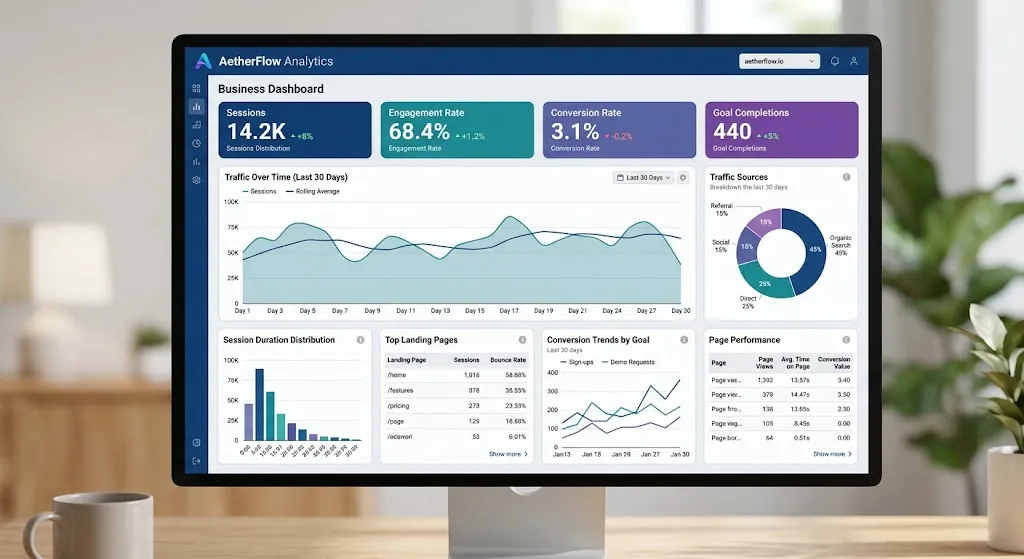
<span style="color: rgb(31, 31, 31); background-color: rgb(240, 244, 249);">Website Analytics Dashboard — realistic analytics interface showing traffic, engagement, conversion rate, goal completions, and performance trends.</span>” /></figure>
</p>
<h2>The ROI of Professional Web Design: Lessons from Case Studies</h2>
<p>One consistent lesson across successful website projects is that strategic web design can generate measurable business value. The ROI of a website redesign depends on factors such as the site’s starting performance, traffic volume, conversion opportunities, project scope, and business objectives. A strategic redesign can create value through improved conversions, stronger search visibility, better customer experience, increased sales, or reduced operational costs.</p>
<h2>Conclusion: Learning From Web Design Case Studies</h2>
<p>Web design case studies provide practical lessons for any business considering a website investment. Whether examining website redesign before-and-after examples, ecommerce web design examples, or B2B website design examples, the pattern is clear: <strong>web design can contribute to measurable business results when design decisions are connected to clear objectives, user needs, conversion opportunities, and performance data.</strong></p>
<p>The most compelling web design case studies document the complete journey—problem identification, strategic approach, implementation, and measured results. They show that professional web design can become a measurable business investment when redesign decisions are tied to clear goals, user experience, conversion opportunities, and performance data.</p>
<p><strong>Ready to improve your website?</strong> Before investing in a complete redesign, identify what’s holding your current website back. Contact Particular Angles to discuss your goals and identify opportunities to improve usability, performance, SEO, and conversions.</p>
<blockquote><p><a href=Contact Particular Angles today to discuss your website’s potential. We’ll review your current website, identify opportunities for improvement, and discuss practical strategies for improving usability, performance, SEO, and conversions.

Particular Angles is a web design and digital strategy agency specializing in custom WordPress development, ecommerce optimization, and B2B digital transformation.

Add a Comment

Your email address will not be published. Required fields are marked *