




Last updated: August 21, 2026
Published: September 2, 2026
Complete Guide to Hiring Web Developers: Roles, Skills, and Interview Questions
Written by the Particular Angles Team
Web development, website management, and digital solutions
Finding and hiring the right web developers is one of the most critical decisions a growing business can make. Whether you’re building your first development team or scaling an existing department, knowing how to hire web developers effectively determines the quality of your digital products, your project timelines, and ultimately your bottom line.
The challenge is clear: The demand for skilled web developers remains competitive, making the hiring process increasingly complex. You need to understand the difference between front-end and back-end roles, identify must-have technical skills, and ask interview questions that reveal a developer’s true capabilities.
This comprehensive guide walks you through every step of how to hire web developers—from defining roles and assessing qualifications to conducting technical interviews and evaluating cultural fit.
How to Hire a Web Developer
Hiring a web developer starts with defining your project’s technical and business requirements. A practical hiring process includes these steps:
- Define your project requirements. Determine what you need the developer to build, maintain, improve, or troubleshoot.
- Choose the type of developer you need. Decide whether your project requires a front-end, back-end, or full-stack developer.
- Create a focused job description. List the essential skills, technologies, responsibilities, experience level, and expected outcomes.
- Review resumes and portfolios. Look for relevant projects, technical experience, code quality, and evidence of individual contributions.
- Conduct a technical assessment. Use a short, realistic exercise that reflects the type of work the developer will perform.
- Ask practical interview questions. Evaluate technical knowledge, problem-solving ability, decision-making, and experience.
- Evaluate communication and collaboration skills. Determine whether the candidate can explain technical concepts clearly and work effectively with others.
- Use a consistent hiring scorecard. Rate candidates against the same criteria so you can compare them objectively.
- Check references and previous work. Where appropriate, verify employment history, project contributions, and professional references.
- Make the offer and plan onboarding. Clearly communicate expectations and give the new developer the documentation, access, and support needed to become productive.
Questions to Ask Before Hiring a Web Developer
Before reviewing resumes or posting a job description, take time to define what your business actually needs. A clear understanding of the project makes it easier to identify the right skills, experience level, and type of developer to hire.
Ask yourself these questions:
What exactly will the developer be responsible for?
Define whether the developer will build a new website, maintain an existing platform, develop custom features, troubleshoot technical issues, improve performance, or handle ongoing development.
Are we building a website, web application, or ecommerce platform?
The type of project determines the technical expertise you need. A WordPress website may require different skills from a custom web application or WooCommerce store.
Do we need someone full-time, part-time, freelance, or contract?
Consider the expected workload, project duration, budget, and level of ongoing support before deciding what type of working arrangement makes sense.
What technologies are already part of our stack?
Identify the platforms, programming languages, frameworks, content management systems, databases, hosting environments, and other technologies the developer will need to work with.
What should the developer accomplish in the first 90 days?
Define realistic early goals, such as completing a website migration, resolving technical issues, improving page performance, launching new features, or establishing development workflows.
Who will manage or review the developer’s work?
Determine who will provide direction, review code, approve changes, communicate priorities, and evaluate performance. Clear ownership helps prevent confusion after the developer joins the team.
Which skills are essential and which are nice to have?
Separate must-have qualifications from skills that can be learned on the job. This prevents you from rejecting strong candidates simply because they don’t match every item on an overly long job description.
Answering these questions first gives you a clearer hiring profile and helps you evaluate candidates based on what your project actually requires rather than simply choosing the person with the longest list of technical skills.
A Practical Perspective on Hiring Web Developers
In practice, the right developer isn’t always the person with the longest list of technologies on their resume. A developer can know several programming languages and frameworks but still be a poor fit if they don’t have experience solving the type of problems your business actually faces.
For small businesses, the platform and project requirements often matter more than the number of technologies a candidate knows. A company running a WordPress or WooCommerce website, for example, may benefit more from a developer who understands WordPress customization, PHP, JavaScript, website performance, security, and ongoing maintenance than from a developer whose experience is primarily focused on building large-scale applications from scratch.
The same principle applies to larger projects. A company developing a custom web application may need developers with experience in APIs, databases, authentication, cloud infrastructure, testing, and deployment rather than someone whose strongest experience is building content-focused websites.
The goal of hiring should therefore be to match the developer’s experience with the actual problem you need to solve. Before reviewing resumes, define what you need the developer to build, maintain, improve, or troubleshoot. Then evaluate candidates based on how closely their experience matches those requirements.
The best candidate isn’t necessarily the developer who knows the most technologies. It’s the developer who can effectively solve the problems your project requires.

Understanding Web Developer Roles and Responsibilities
Before you can effectively hire web developers, you need clarity on the specific roles you’re hiring for. The web development field has evolved into specialized positions, each requiring distinct skill sets and experience levels. Understanding these distinctions helps you write accurate job descriptions and identify candidates with the right expertise.
The three primary web development roles are front-end developers, back-end developers, and full-stack developers. Your hiring decision depends on your project scope, team structure, and technical needs.
Front-End Developer Responsibilities
Front-end developers build the user-facing portion of web applications—everything users see and interact with. This role demands both technical precision and creative problem-solving. Front-end developers use HTML, CSS, and JavaScript to create responsive, accessible interfaces that work seamlessly across all devices and browsers.
A strong front-end developer job description should include translating UI/UX designs into code, optimizing page load performance, ensuring cross-browser compatibility, implementing accessibility standards, and collaborating with UX designers and backend developers. These professionals must understand user experience principles and stay current with rapidly evolving frameworks like React, Vue, and Angular.
Back-End Developer Responsibilities
Back-end developers work on server-side logic, databases, APIs, and application architecture—the invisible infrastructure that makes web applications function. Back-end developer skills differ significantly from front-end work because the focus shifts to scalability, security, data management, and system performance.
When building a back-end developer job description, emphasize database design and optimization, API development and integration, server configuration, security implementation, code architecture, and performance optimization. Back-end developers typically specialize in languages like Python, Java, Node.js, PHP, or Go, and must understand cloud platforms like AWS or Azure.
Full-Stack Developers
Full-stack developers work across both front-end and back-end systems, making them valuable for smaller teams or startups with diverse project needs. However, “full-stack” doesn’t mean equal expertise in all areas—most developers have a stronger specialty while maintaining competency across the stack.
Be realistic when hiring full-stack developers: they typically excel in one area while having solid foundational knowledge in the other. Integrating digital marketing with web development can benefit from a full-stack perspective because these developers understand both customer-facing functionality and back-end systems.
Essential Web Developer Skills to Look For
Technical and professional skills matter enormously when hiring web developers, but they’re not the complete picture. Successful developers combine hard technical abilities with soft skills that enable collaboration, learning, and problem-solving. Your interview process should rigorously assess both categories.
Core Technical Skills
The technical skills you prioritize should depend on the role, technology stack, and project requirements. For front-end roles, this means:
- Advanced HTML and CSS knowledge, including responsive design principles
- JavaScript competency with modern ES6+ syntax
- Experience with at least one major framework (React, Vue, or Angular)
- Understanding of version control systems, particularly Git
- Basic knowledge of web performance optimization
- Familiarity with browser developer tools and debugging techniques
For back-end positions, prioritize:
- Proficiency in at least one server-side programming language
- Database design and SQL knowledge
- RESTful API design and development
- Authentication and security best practices
- Experience with version control and deployment pipelines
- Understanding of cloud platforms and containerization (Docker)
Problem-Solving and Analytical Thinking
Technical knowledge becomes more valuable when paired with strong problem-solving abilities. During interviews, present realistic coding challenges that require logical thinking rather than memorized syntax. Strong problem-solving ability is particularly important in web development because developers frequently need to diagnose unfamiliar issues, evaluate trade-offs, and develop solutions that balance technical and business requirements.
Ask candidates to explain their thought process as they solve problems. How do they approach unfamiliar challenges? Can they break complex problems into manageable pieces? Do they ask clarifying questions before diving into solutions? These behaviors indicate developers who will contribute positively to your team.
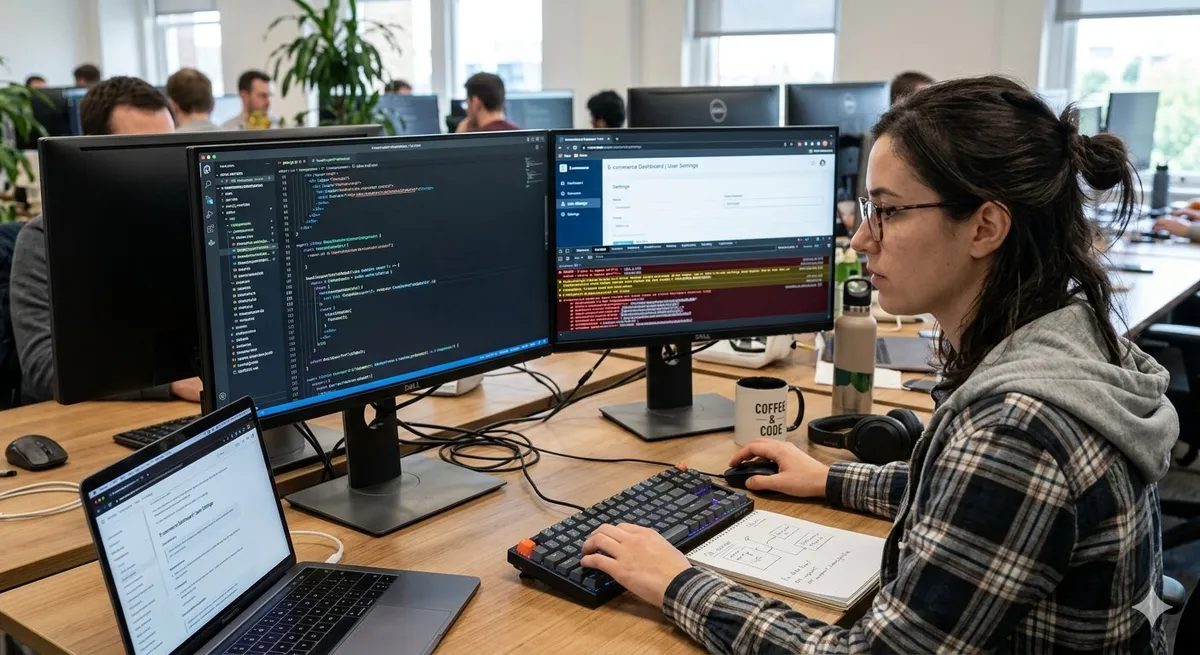
Communication and Collaboration Skills
Technical skill alone doesn’t guarantee team success. Developers who communicate clearly, document their work thoroughly, and collaborate effectively with designers, product managers, and other developers create better outcomes. Successful web projects often depend on strong communication between developers, designers, project managers, and other stakeholders.
During interviews, assess how candidates explain technical concepts to non-technical stakeholders. Do they listen carefully to questions? Can they admit knowledge gaps without defensiveness? How do they respond to feedback? These indicators reveal whether a developer will integrate well with your team.
Structuring Your Web Development Hiring Process
An effective hiring process for web developers balances speed with thoroughness. Candidates have options in a competitive market, so a prolonged hiring process increases the risk that your ideal candidates accept offers elsewhere. Simultaneously, rushing the hiring decision leads to costly mistakes.
A streamlined hiring process typically involves four stages: resume screening, initial technical assessment, in-depth technical interview, and culture/team fit discussion. Each stage should eliminate candidates who don’t meet minimum qualifications while advancing those who demonstrate promise.
Resume and Portfolio Review
The resume screening stage immediately filters for baseline qualifications. However, portfolios matter more than resumes for development roles. A strong portfolio demonstrates a developer’s actual capabilities and work quality. When evaluating portfolios, look for:
- Projects that match your technical stack or demonstrate transferable skills
- Code quality and attention to detail in finished products
- Complexity appropriate to the seniority level you’re hiring
- Evidence of problem-solving approaches and decision-making rationale
- GitHub profiles showing consistent contributions and code quality
- Written explanations of project challenges and solutions
Don’t just look at the finished website or application—ask candidates what they personally contributed to each project. A polished portfolio piece doesn’t necessarily show whether they wrote the code, customized an existing theme or framework, collaborated with a larger team, or handled the project independently. Asking about their specific responsibilities can give you a clearer picture of their actual skills and experience.
A developer who contributes regularly to open-source projects, maintains a technical blog, or has a strong GitHub profile may demonstrate genuine interest in development and a commitment to continued learning.
Technical Screening and Assessment
Before investing time in comprehensive interviews, use technical assessments to verify that candidates possess claimed skills. Many teams use coding assessments, coding challenge platforms, or take-home assignments to evaluate technical abilities in a realistic context.
The assessment approach should align with your role requirements. For a front-end position, test HTML/CSS/JavaScript skills with tasks like building a responsive component or debugging existing code. For back-end roles, assess database design, API creation, or algorithm proficiency. Keep assessments focused and time bound. A short, realistic exercise is usually more useful than a large take-home project that requires several days of unpaid work.
Conducting Effective Technical Interviews
Technical interviews reveal how candidates approach problems, think through solutions, and communicate their reasoning. Rather than asking candidates to recite facts or write perfect code without resources, simulate the actual working environment where developers have access to documentation and debugging tools.
Essential Interview Questions for Web Developers
Craft effective web developer interview questions that explore both technical depth and practical thinking. Here are categories of effective questions:
Conceptual Questions:
- “Explain the difference between CSS Grid and Flexbox. When would you use each one?”
- “Walk us through how the browser renders a webpage from the moment a user enters a URL.”
- “What’s the difference between SQL and NoSQL databases? What are the trade-offs?”
- “Explain the concept of middleware in web development and provide a real-world example.”
Practical Problem-Solving:
- “You’ve inherited a codebase with significant performance issues. How would you identify and fix them?”
- “A user reports that a feature works on their phone but not their laptop. How would you troubleshoot this?”
- “Design the database schema for a simple e-commerce platform. Explain your decisions.”
Experience-Based Questions:
- “Tell me about a project where you had to learn a new technology quickly. What approach did you take?”
- “Describe a situation where you had to refactor legacy code. What challenges did you face?”
- “When have you had to communicate technical concepts to non-technical stakeholders?”
Behavioral Interview Questions
Beyond technical capabilities, assess whether candidates demonstrate the behaviors you value. Behavioral interviews can help employers evaluate communication, collaboration, ownership, and problem-solving beyond technical skills. Ask questions like:
- “Tell me about a time you disagreed with a design or product decision. How did you handle it?”
- “Describe a project that failed. What did you learn from it?”
- “How do you stay current with web development trends and new technologies?”
- “Tell me about your most significant contribution to a team project.”

Using a Web Developer Hiring Scorecard
After completing interviews, use a simple scorecard to evaluate candidates consistently. Instead of relying on overall impressions, rate each candidate against the same criteria and compare their strengths with the actual requirements of the role.
A practical starting point is:
Technical skills — 30%
Evaluate the candidate’s knowledge of the technologies required for the position, such as HTML, CSS, JavaScript, PHP, databases, APIs, frameworks, security, or performance optimization.
Relevant project experience — 25%
Look for experience solving problems similar to those your business faces. Consider the candidate’s previous projects, responsibilities, technology stack, and level of ownership.
Problem-solving ability — 20%
Assess how the candidate approaches unfamiliar problems, identifies potential causes, evaluates trade-offs, and explains their reasoning.
Communication — 15%
Consider whether the candidate can explain technical concepts clearly, ask useful questions, document their work, and communicate effectively with non-technical stakeholders.
Team and collaboration — 10%
Evaluate how the candidate handles feedback, disagreements, shared responsibilities, and collaboration with designers, marketers, project managers, and other developers.
These percentages are not fixed requirements. Adjust the weighting based on the position. For example, a senior backend developer may require greater emphasis on architecture, databases, security, and system design, while a front-end developer may require more emphasis on JavaScript, accessibility, responsive design, and user experience.
For each category, use a consistent rating scale from 1 to 5:
1 — Limited: Does not currently meet the requirement.
2 — Developing: Has some exposure but needs significant support.
3 — Competent: Meets the expected requirements.
4 — Strong: Exceeds most requirements.
5 — Excellent: Demonstrates exceptional expertise and relevant experience.
The goal isn’t to find the candidate with the highest score in every category. Instead, use the scorecard to identify the candidate whose strengths best match the project’s actual needs.
For example, a developer with excellent general programming knowledge but limited WordPress experience may not be the strongest choice for a business that needs someone to maintain and customize a WooCommerce website. Conversely, a developer with strong WordPress, PHP, JavaScript, performance, and troubleshooting experience may be a better fit even if they have less experience with unrelated technologies.
A structured scorecard also helps reduce inconsistent evaluations between interviewers and makes it easier to explain why one candidate was selected over another.
Evaluating Candidates Beyond Technical Skills
While technical abilities form the foundation, successful long-term hires demonstrate qualities that extend beyond coding proficiency. Working style, communication, collaboration, and values alignment significantly impact team dynamics and retention.
Assessing Learning Ability and Growth Mindset
The web development landscape changes constantly. Developers who thrive are those who embrace continuous learning rather than those who rely on static knowledge. During interviews, explore how candidates approach new challenges and unfamiliar technologies.
Ask about their learning process: Do they read documentation? Study open-source code? Contribute to communities? Take online courses? The most valuable developers are intellectually curious and enjoy problem-solving for its own sake, not just because their job requires it.
Team Compatibility and Working Style
A developer with exceptional technical skills can become a liability if they create friction within your team. Assess whether candidates will collaborate effectively with your existing team members. Include team members in interviews when possible—their perspective matters for long-term compatibility.
During interviews, explore how candidates describe past teams, handle conflict, and view collaboration. Do they take ownership of problems, or do they blame others? Can they articulate how they’ve helped other team members succeed? Small business web development teams particularly benefit from developers who are self-sufficient and collaborative.
Red Flags in the Hiring Process
Certain warning signs should trigger deeper investigation or reconsideration. A candidate who becomes defensive when asked to explain code decisions, can’t articulate their technical choices, or dismisses alternative approaches might struggle with collaboration. Similarly, candidates who claim expertise in vastly disparate technologies without depth in any single area warrant skepticism.
Be wary of candidates who can’t discuss their own projects in detail or who seem unprepared for interviews. These behaviors suggest either dishonest portfolio representation or lack of genuine engagement with the role. Trust your instincts when something feels off—hiring costs are high enough that it’s worth waiting for better candidates.
Making Your Offer and Onboarding Successfully
Once you’ve identified your ideal candidate, move quickly to extend an offer. In competitive hiring markets, delays cost you top talent. Beyond salary negotiation, clarify expectations around team structure, project involvement, professional development, and career growth opportunities.
Onboarding is equally critical as hiring. Provide thorough documentation, assign a mentor or buddy, and create a structured first-week plan that builds momentum and confidence. Quality onboarding can help new developers understand expectations, become productive sooner, and integrate more effectively with the team.
Consider how new hires integrate with your existing tech stack. If your organization uses WordPress, ensure onboarding covers your specific customization approaches, maintenance protocols, security practices, and internal workflows.
Learning how to hire web developers effectively transforms your organization’s development capabilities and project success rates. By clearly defining roles, identifying essential technical and soft skills, structuring a rigorous yet efficient hiring process, and conducting thorough interviews, you attract and retain developers who drive real business impact.
The web developer talent market remains highly competitive—the best developers have multiple opportunities. Your company succeeds in this market by demonstrating clear technical vision, valuing developer growth, and building genuinely collaborative teams. This guide provides the framework; your execution determines results.
Ready to strengthen your web development capabilities?
Contact Particular Angles to discuss your website, application, or digital project requirements. Our team can help you determine the technical expertise your project needs and identify the right development approach for your business.
This guide was created by the team at Particular Angles based on practical experience with web development, website management, and digital projects. The goal is to help businesses understand the technical skills, project experience, and problem-solving abilities to consider when evaluating web developers. Hiring requirements can vary depending on the technology stack, project complexity, and long-term business goals, so companies should adapt the recommendations in this guide to their specific circumstances.