




Last updated: October 8, 2026
How to Hire a Web Design Agency: The Complete RFP Guide for Tech Startups
Finding the right web design agency to hire can make or break your tech startup’s online presence. With hundreds of agencies claiming expertise, the decision feels overwhelming, yet it’s one of the most critical investments you’ll make. This guide walks you through the entire vetting process, from defining your needs to signing a contract, using a professional Request for Proposal (RFP) framework.
The stakes are high. According to Statista research, 75% of users judge a company’s credibility based on website design quality. A poorly executed site doesn’t just look bad it tanks conversions and wastes your marketing budget. By following this proven process, you’ll avoid costly mistakes and partner with an agency that actually delivers results.

Why Most Tech Startups Fail When Selecting a Web Design Partner
The typical startup hiring process is chaotic. Founders search for a web design agency near me, scroll through portfolios, and pick the cheapest quote. Six months later, they’re frustrated with missed deadlines, poor communication, and a website that doesn’t convert.
Choosing a web design agency for startups requires more than comparing portfolios and prices. The right partner should understand startup budgets, MVP development, scalability, changing requirements, and the pressure to launch quickly.
This happens because startups skip the critical discovery phase. They don’t clarify project scope, define success metrics, or vet agency experience with similar businesses. HubSpot’s 2026 Agency Report shows that 58% of business-to-agency relationships fail due to unclear expectations and scope creep.
The solution? A structured RFP process. This doesn’t require hiring a procurement expert it just means asking the right questions upfront and evaluating responses systematically.
Step 1: Define Your Project Scope and Goals Before Reaching Out
Before you contact a single agency, get crystal clear on what you’re actually building. Vague briefs lead to vague proposals. Spend time writing a one-page project overview that covers:
- Business objectives: Are you launching an MVP, redesigning an existing site, or building a custom platform?
- Target audience: Who are your users? What problem do they have?
- Core features: List must-haves versus nice-to-haves.
- Timeline: When do you need to launch?
- Budget range: This prevents wasting time on misaligned proposals.
Tech startups often skip this step because they think agencies will “figure it out.” They won’t. The more specific you are, the better proposals you’ll receive. Google’s business productivity guides recommend documenting project requirements in writing before vendor selection this creates accountability on both sides.
Questions to Answer Before Your RFP
Will your site need e-commerce functionality, user authentication, API integrations, or content management systems? Will you launch multiple features in phases or aim for a full feature set on day one? What’s your technical debt tolerance do you need scalable architecture from day one, or can you refactor later?
Documenting these decisions upfront prevents scope creep and ensures agencies bid on the same project.
Building Your RFP: Essential Questions for Web Design Agencies
An RFP doesn’t need to be a 50-page corporate document. For a tech startup, 10-15 focused questions give you the data needed to compare agencies fairly.
Technical Capability Questions
- What’s your technology stack recommendation, and why?
- How do you approach responsive design and cross-browser testing?
- What’s your process for site speed optimization and Core Web Vitals?
- Can you provide examples of custom web development work similar to our project?
- How do you handle backend development, databases, and API integrations?
When reviewing responses, look for specificity. An agency that says “we build fast sites” is vague. One that mentions “we achieve 90+ Lighthouse scores through image optimization, lazy loading, and CDN integration” shows expertise. Reference our guide on custom web design versus template solutions when evaluating technical approaches.
Experience and Portfolio Questions
- Show me 3-5 portfolio projects similar in scope, technology, or industry.
- Can you provide client references for projects completed in the last 18 months?
- What’s your experience with tech startups specifically?
- Have you worked on SaaS platforms, mobile-first applications, or platforms requiring complex integrations?
Don’t just look at portfolio aesthetics. Dig into the business outcomes. Did conversions improve after launch? What was the timeline? Were there technical challenges, and how did the agency handle them? A strong portfolio tells a story of results, not just pretty designs.
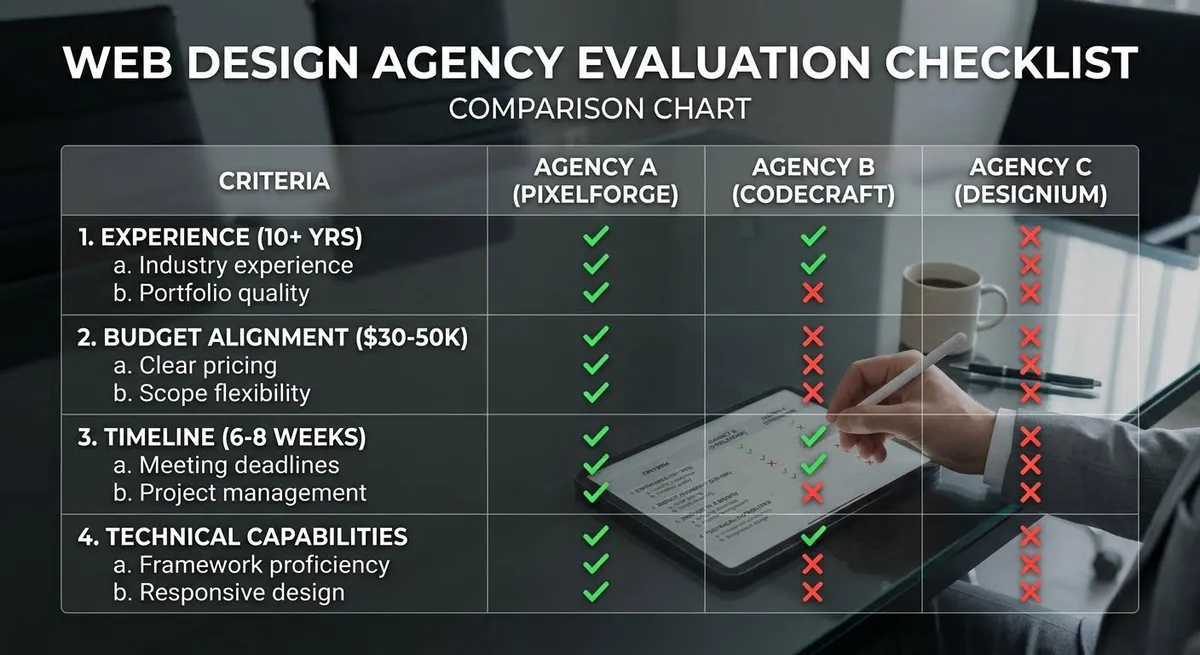
Agency Selection Criteria: The Key Metrics That Matter
Once proposals arrive, you need a fair evaluation framework. Create a scoring sheet with weighted categories. Here’s a proven model for tech startups:
Communication and Project Management (25% weight)
- Does the agency respond quickly and clearly?
- Who is your dedicated point of contact a project manager or senior strategist?
- How do they handle scope changes and timeline adjustments?
- What’s their update cadence weekly standups, biweekly demos, or monthly check-ins?
Poor communication kills more projects than technical incompetence. An agency that responds within 24 hours and provides weekly progress updates will save you months of frustration. Understanding how web development integrates with your broader digital strategy also requires strong ongoing communication throughout the project.
Technical Expertise and Scalability (25% weight)
- Are they recommending modern, maintainable technology stacks?
- Do they have experience with your specific tech stack preferences?
- Can they architect for growth supporting 10x user increases without rebuilding?
- What’s their security and compliance approach?
Timeline and Deliverables (20% weight)
- Is their proposed timeline realistic given project scope?
- Do they include testing, deployment, and launch support?
- What happens if timelines slip do they adjust scope or just push dates?
Cost and Value (20% weight)
- Is pricing broken down by milestone or phase?
- Are there contingency fees for scope changes?
- Do they offer post-launch support and maintenance?
Cultural Fit and Long-Term Partnership Potential (10% weight)
- Do they understand startup culture and growth constraints?
- Will they serve as a strategic partner or just execute your specs?
- Are they invested in your success or just collecting a paycheck?
The cheapest proposal often becomes the most expensive when you factor in rework, communication overhead, and delayed launch. Aim for the agency with the best overall score, not the lowest bid.
Vetting Agency Credentials and Past Performance
Never take agency claims at face value. Here’s how to verify expertise:
Check References Thoroughly
Ask for at least three recent client references ideally past startups or growth-stage companies. When you call, ask specific questions: Did the agency deliver on time? Were there cost overruns? How responsive was the team? Would you hire them again?
Red flags: An agency that can’t provide references, clients who had poor experiences, or references who only say nice things without specifics (“great team” without examples).
Review Past Project Case Studies
Look beyond the design. Strong case studies explain the problem, the solution, and the measurable results. Did conversion rates improve? Did load time decrease? Did user engagement grow? Our portfolio case studies demonstrate detailed project outcomes and learnings showing how discovery informs strategy.
Assess Team Structure and Stability
Who will actually do the work the senior strategist in your initial meetings or junior developers? Will your project get continuity or experience constant staff changes? Ask how many team members have been there for 2+ years. Stability matters for long-term partnerships.
Understanding Custom Web Development Versus Template Solutions
During your RFP process, agencies may recommend different approaches. Understanding the tradeoffs matters for tech startups.
Custom web development offers flexibility, scalability, and unique differentiation. Template-based solutions are faster and cheaper. For startups building competitive advantage through technology, custom development usually wins. Our detailed comparison of custom web design versus templates breaks down when each approach makes sense for your specific goals.
Don’t let an agency push you toward their preferred approach without considering your actual needs. A good agency will recommend what’s best for your business, even if it’s less profitable for them.
Negotiating Terms and Avoiding Common Contract Pitfalls
Before signing, understand the contract terms:
Milestone-Based Payments
Never pay 100% upfront. Structure payments tied to deliverables: 30% upon signing, 40% at mid-project milestone, 30% upon launch. This ensures the agency stays motivated and you retain leverage if quality slips.
Change Order Process
Scope creep is inevitable. Ensure the contract specifies how changes are requested, estimated, and approved. An undefined change process leads to arguments and cost overruns.
Timeline and Penalty Clauses
Is the timeline firm or estimated? What happens if the agency misses deadlines do you get credits or refunds? What happens if you delay decisions, delaying the project?
Post-Launch Support
Include 30-60 days of free bug fixes after launch. Clarify whether ongoing maintenance, hosting, and updates are included or billed separately. Tech startups often underestimate post-launch costs.
Intellectual Property Rights
You should own all code, design assets, and content created during the project. Avoid agencies that retain licensing rights or lock you into their infrastructure.
Consider consulting a tech attorney if your contract exceeds $50K. The legal review typically costs $500-$1,000 but prevents disputes worth thousands.
The First 30 Days: Setting Up for Success After Hire
Once you’ve signed, the real work begins. Structure the kickoff properly:
- Discovery workshop: Full-day alignment session with your team and the agency. Map user flows, define success metrics, and align on technical approach.
- Style guide and design system: Establish design standards early. This prevents rework and ensures consistency.
- Weekly standups: 30-minute meetings every Monday. This catches problems early.
- Milestone review demos: Every two weeks, see progress and provide feedback. Catching misalignment early prevents costly rework.
- Escalation path: Know who to contact if issues arise. Escalate early don’t let small problems become big ones.
The first 30 days are critical for setting expectations and establishing communication patterns that will define your entire working relationship.
Red Flags: When to Walk Away from an Agency
Even with a structured process, some agencies aren’t the right fit. Walk away if you see:
- Slow communication more than 24-hour response times to urgent questions
- Vague proposals they’re parroting your brief back without strategic recommendations
- Pressure to decide quickly or commit to unrealistic timelines
- Missing details in contracts no change order process, unclear deliverables, or undefined timeline
- References who express concern or hesitation
- Bait-and-switch tactics senior strategists in sales meetings, junior developers doing actual work
Trust your instincts. If something feels off during the vetting process, it will feel worse during the six-month project.

Budget Benchmarks for Tech Startups
What should you actually budget? Here are realistic ranges for 2026:
- Brochure site or MVP: $15K-$35K. Perfect for initial market validation.
- Custom SaaS platform: $50K-$150K+. Complex architecture, user authentication, and integrations add cost.
- E-commerce platform: $30K-$80K. Depends on product complexity and payment integrations.
- Full digital product: $100K-$250K+. Design system, mobile app, and ongoing support included.
Lower budgets don’t guarantee lower quality, but they do mean making tradeoffs. An agency quoting $8K for a custom SaaS platform is likely cutting corners on architecture, testing, or post-launch support. Be realistic about what technology costs.
For detailed budget planning, reference our guide to custom web design costs and ROI calculations, which includes benchmarks and hidden expense planning.
Key Takeaways: Your Hiring Checklist
Before reaching out to agencies: Define your project scope, goals, timeline, and budget range. Write a one-page project overview.
During the RFP process: Ask consistent questions, request specific examples, and thoroughly vet references. Score proposals using a weighted rubric focusing on communication, technical expertise, and cultural fit not just price.
Before signing: Understand contract terms, establish a clear change order process, and ensure milestone-based payments protect both parties.
After hire: Run a proper discovery workshop, establish weekly communication, and review milestones every two weeks. Catch misalignment early.
Ready to Hire a Web Design Agency?
Finding the right partner to hire a web design agency requires patience, structure, and clear evaluation criteria. Follow this RFP process, ask hard questions, and trust your instincts. The right agency isn’t the cheapest it’s the one that understands your business, communicates clearly, and delivers results.
If you’re a tech startup in the Tampa area or beyond, Particular Angles has spent over a decade helping startups build products that scale. We specialize in custom web development, SaaS platforms, and digital strategy for growth-stage companies. Contact Particular Angles today to discuss your project, request case studies from similar companies, or explore how we’d approach your specific challenge.
About the Author: This guide was written by the team at Particular Angles, a Tampa-based web design and development agency specializing in custom solutions for tech startups and SaaS companies. Our team brings 15+ years of combined experience in digital strategy, web development, and helping early-stage companies validate ideas and scale platforms. We’ve vetted dozens of startup projects, learned what works in RFP processes, and built this guide to help founders navigate agency selection with confidence.