




Last updated: October 6, 2026
SEO vs PPC: Which Digital Marketing Strategy Should You Choose?
When it comes to driving traffic to your website, two strategies dominate the digital landscape: search engine optimization (SEO) and pay-per-click (PPC) advertising. Business owners often face the critical decision of choosing between SEO vs PPC, not realizing that the answer might not be either/or, but rather which one deserves your budget first. Understanding the nuances of organic search strategy versus paid search marketing is essential for maximizing your digital marketing ROI and achieving sustainable growth.
Both channels deliver qualified traffic from search engines, but they operate on fundamentally different principles, timelines, and cost structures. In this comprehensive guide, we’ll break down the advantages and disadvantages of each approach, provide real-world data to inform your decision, and help you determine which strategy or combination of strategies aligns with your business goals.
Understanding the Core Differences: Organic Search Strategy vs Paid Search Marketing
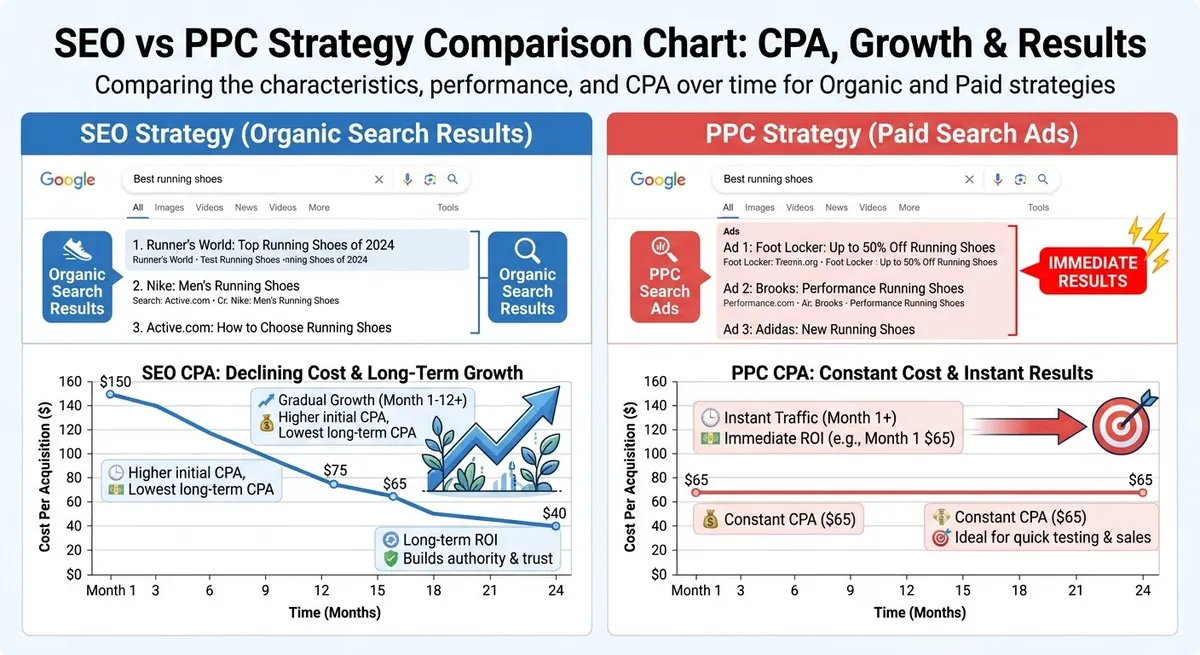
The fundamental distinction between SEO and PPC lies in how you acquire visibility on search engine results pages (SERPs). SEO focuses on earning organic rankings through content quality, technical optimization, and authority building. It’s a long-term investment in your website’s natural search presence. PPC, conversely, involves paying for immediate placement above organic results; you’re bidding on keywords and paying each time someone clicks your ad.
This structural difference creates dramatically different cost dynamics. With PPC, your cost per acquisition depends on your click-through rate, conversion rate, and the competitive landscape of your keywords. An enterprise SaaS company might pay $15-$50 per click for high-intent B2B keywords, while a local service business might pay $1-$5. SEO requires upfront investment in content creation, technical improvements, and link building, but once your pages rank, organic traffic becomes essentially free.
SEO can reduce customer acquisition costs over time by generating qualified organic traffic without requiring a payment for every click. However, this advantage only materializes after the initial 6-12 month investment period.
The Time-to-Results Reality: When Speed Matters for Digital Marketing ROI
One of the most compelling arguments for PPC is immediate visibility. The moment your campaign goes live, your ads appear on search results pages. This is invaluable when you’re launching a new product, running a seasonal promotion, or operating in a competitive market where waiting 6-12 months for organic rankings simply isn’t feasible.
SEO, by contrast, demands patience. SEO timelines vary significantly by website authority, competition, keyword difficulty, and industry. Search Engine Journal notes that new sites may reach first-page rankings for non-competitive keywords in roughly 1-4+ months, while competitive keywords can take 9-12+ months or longer. This timeline reflects the time needed for Google to crawl your content, evaluate your domain authority, and build confidence in your expertise.
For established businesses, however, SEO can accelerate competitive advantage. If your competitors are relying solely on PPC, investing in SEO creates a moat around your business through sustainable traffic that competitors can’t outbid. This is particularly valuable for SEO services for small businesses seeking organic growth, where marketing budgets are tight and long-term sustainability matters more than short-term spikes.
Timeline Comparison: First 12 Months
- PPC: Immediate traffic (days 1-7), ROI dependent on landing page quality and conversion funnel
- SEO: Minimal traffic (months 1-3), accelerating growth (months 4-8), significant traffic (months 9-12+)
- Hybrid Approach: PPC generates immediate conversions while SEO builds; both mature after 12 months
Cost Per Acquisition Analysis: Breaking Down Digital Marketing ROI
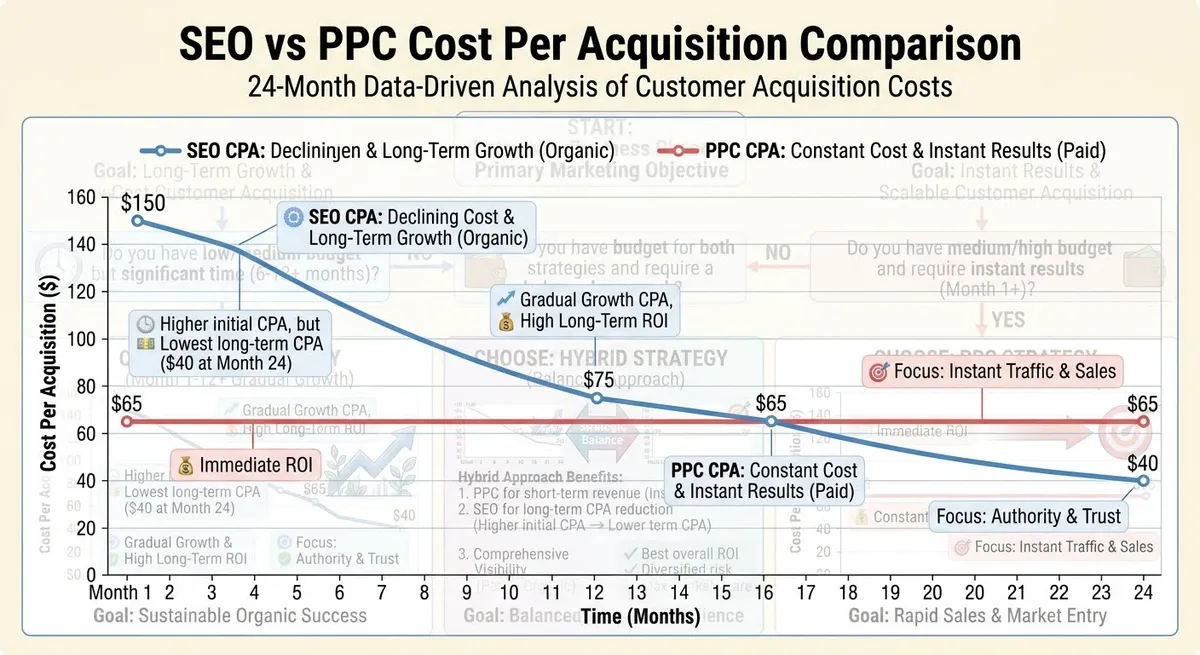
When evaluating cost per acquisition between these channels, the numbers tell a compelling story but only when you measure correctly. Many business owners underestimate SEO costs because they focus solely on ranking without accounting for the full value chain.
PPC Cost Structure: You pay every single time someone clicks your ad. If your keyword has a $2 average cost per click and your conversion rate is 3%, your cost per acquisition is approximately $67 ($2 ÷ 0.03). Multiply that by 100 conversions monthly, and you’re spending $6,700 just on paid search.
SEO Cost Structure: SEO usually requires upfront investment in content, technical optimization, website improvements, and authority building. Unlike PPC, however, organic traffic does not incur a direct cost for every click. As rankings and organic visibility improve, the same content can continue generating traffic and leads over time.
The point at which SEO becomes more cost-efficient than PPC varies by industry, competition, conversion rates, and the quality of the SEO campaign. Businesses should compare cumulative acquisition costs and revenue over time rather than relying on a fixed timeframe.
Keyword Intent Targeting: Where Each Channel Excels
The quality of traffic differs meaningfully between organic search strategy and paid search marketing. PPC excels at high-intent keywords where users are actively searching with purchase intent. Someone typing “buy cloud hosting” or “schedule software demo” represents immediate opportunity, and PPC’s ability to target these high-intent terms precisely is unmatched.
SEO captures a broader spectrum of intent, including informational queries that build brand awareness and establish thought leadership. A prospect searching “how to optimize database performance” isn’t buying today, but your comprehensive guide ranking for that query builds trust, establishes expertise, and captures them earlier in their buyer journey.
Consider a Tampa-based web design agency. PPC might target “hire web design agency Tampa” (high-intent, expensive keywords), while SEO might target “web design trends 2026” or “how to hire a web developer.” The PPC traffic converts faster; the SEO traffic builds sustainable authority. This is why integrating digital marketing and web design strategy requires both channels working in concert.
Keyword Performance by Intent Type
- Transactional Keywords: PPC wins immediate ROI on high-intent searches
- Informational Keywords: SEO wins lower competition, builds authority, captures early-stage buyers
- Navigational Keywords: Either users know the brand but SEO is more cost-effective
- Commercial Investigation: Hybrid approach PPC for urgency, SEO for authority and alternatives
Scalability and Long-Term Business Growth
One critical factor often overlooked in the PPC vs SEO debate is scalability. PPC scales linearly with budget: spend more, get more clicks, up to a saturation point where auction dynamics and ad fatigue set in. But every additional dollar you spend carries the same cost per click.
SEO can become more efficient as domain authority and topical relevance grow. After establishing strong topical coverage, additional high-quality content can benefit from existing authority and may gain visibility more efficiently. This compounding effect can make SEO increasingly valuable for businesses planning long-term growth.
This advantage is particularly pronounced for small business website design seeking to impact revenue, where marketing budgets are limited and long-term sustainability is essential. A small business investing consistently in organic search strategy can build a growing stream of organic traffic over time. That same budget in PPC, sustained for three years, simply generates consistent paid traffic that evaporates when you stop spending.
Brand Building and Market Positioning
Beyond immediate ROI metrics, SEO builds brand equity that PPC cannot. When your content ranks organically for important keywords, you’re not just acquiring customers; you’re establishing your company as a trusted authority in your industry. This brand value extends far beyond the immediate click, influencing word-of-mouth referrals, partnership opportunities, and employee recruitment.
PPC builds brand awareness through repetition and positioning, but users frequently develop ad blindness. They skip paid ads instinctively and click organic results instead. Organic and paid search can each contribute meaningful traffic, and the balance varies depending on the query, industry, competition, and search-result layout.
For competitive markets where differentiation matters like B2B SaaS, professional services, or luxury goods ranking organically for important keywords signals authority that PPC simply cannot replicate. If your SEO strategy strengthens your B2B SaaS web design positioning, you’re building moats against future competitors.
Choosing Your Strategy: A Framework for Decision-Making
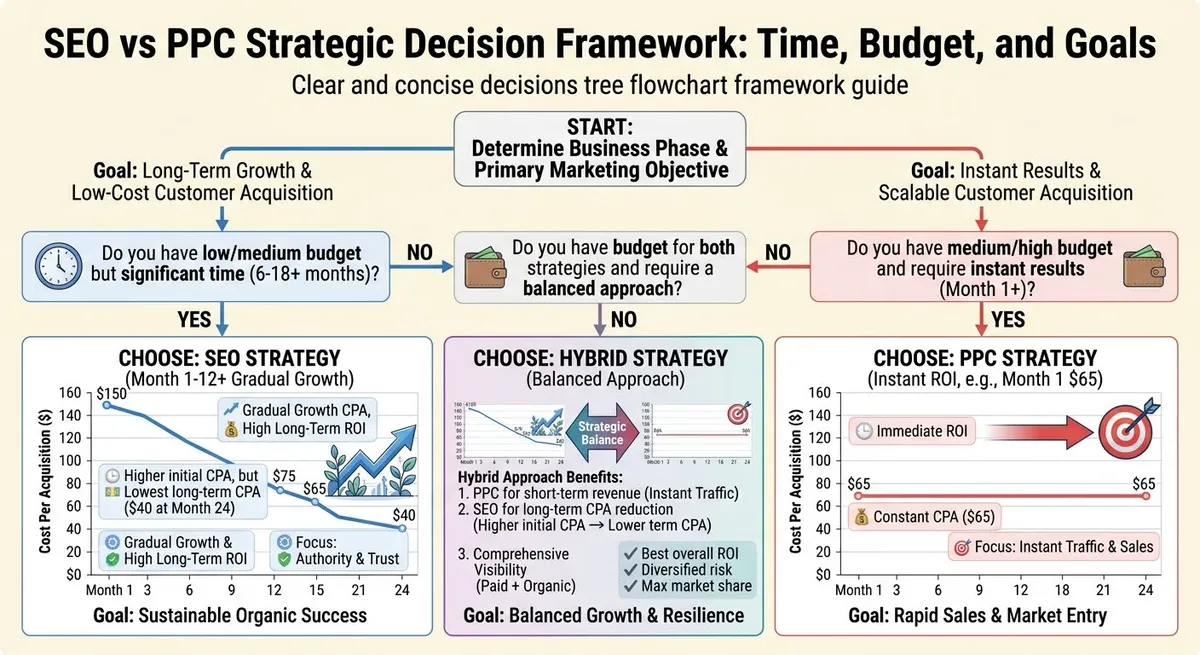
The real question isn’t SEO versus PPC; it’s which one to prioritize first and how to allocate your ongoing budget. Here’s a practical framework:
Choose PPC If:
- You need results within 30-90 days (new product launch, seasonal campaign, time-sensitive promotion)
- Your industry has extreme seasonal fluctuations and you need to maximize peak periods
- Your competition is so entrenched that organic rankings would take 18+ months to achieve
- You have a proven landing page and conversion funnel ready to scale immediately
- Your customer lifetime value justifies high cost per acquisition in the short term
Choose SEO If:
- You’re planning 18+ month growth and want to build sustainable competitive advantage
- Your industry experiences long buyer journeys with multiple touchpoints
- Your marketing budget is modest and needs to compound over time
- You operate in a local market where consistent visibility builds reputation and trust
- You want to capture informational and educational queries that build brand authority
Choose a Hybrid Approach If (Recommended for Most Businesses):
- You have budget for both channels and want to maximize total addressable market
- You’re in a competitive industry where leaving either channel uncontested is risky
- You want PPC to generate immediate conversions while SEO matures
- You can use SEO data to inform PPC keyword strategy and landing page optimization
A hybrid approach can give businesses the benefits of both channels. Your website design becomes the foundation for both channels, and a custom web design approach can help ensure your site is built to convert both paid and organic traffic efficiently.
Optimizing Your Landing Pages for Both Channels
Whether you’re running PPC campaigns or driving organic traffic through SEO, your landing page is where strategy meets conversion. A high-performing landing page is non-negotiable for maximizing digital marketing ROI from either channel.
For PPC, your landing page must match the promise of your ad copy precisely. If your ad emphasizes “free 14-day trial,” that offer must be prominently featured above the fold. Users are primed by your ad copy and have high intent. Poor landing page alignment can cause an immediate bounce.
For SEO, your landing page must satisfy the search intent behind the query. A “how to optimize database performance” ranking should deliver comprehensive, well-structured guidance that demonstrates expertise. The page must be technically sound, mobile-optimized, and structured to keep readers engaged.
Both channels benefit from conversion rate optimization best practices that eliminate mistakes killing your ROI. Clear value propositions, trust signals, compelling calls-to-action, and fast loading speeds matter equally whether traffic arrives via organic search or paid ads.
Attribution and Measurement Challenges
One often-overlooked complexity: accurately attributing revenue to SEO versus PPC in a multi-touch customer journey. A prospect might discover your company through organic search, click a PPC ad weeks later, and convert. Which channel deserves credit?
Most analytics platforms default to last-click attribution, crediting the final channel before conversion. This typically inflates PPC credit and undervalues SEO’s role in building awareness earlier in the journey. Advanced attribution models account for this, but setup complexity means many businesses lack accurate channel data.
Regardless of which channel you choose, invest in proper analytics infrastructure. Track conversions, revenue, and customer lifetime value by channel. This data will inform your budget allocation decisions more accurately than generic benchmarks ever could.
The Hybrid Reality: Why Most Successful Businesses Use Both
In our experience working with businesses across industries, the most successful approaches combine SEO and PPC strategically. Here’s why:
PPC provides immediate market validation. Before investing heavily in SEO content, test your messaging, offers, and landing pages with PPC. The data you gather, including click-through rates, conversion rates, and cost per acquisition, informs your SEO strategy.
Keywords that convert well in PPC deserve organic targeting.
SEO provides sustainable competitive advantage. Once your organic traffic compounds, you’ve built a defensible business asset. Your website generates leads while competitors pay for each one.
Together, they dominate search results. When users search your target keywords, they see both your organic result and your paid ad. This increases your share of voice, click-through rates, and brand recall. It’s a powerful psychological effect: if you appear twice on the first page, you must be important.
This integrated approach requires that your web development and digital marketing align strategically. Your website infrastructure, content management system, and analytics tracking must support both channels simultaneously.
Conclusion: Making Your SEO vs PPC Decision
The question of SEO vs PPC doesn’t have a universal answer. It depends on your timeline, budget, competitive landscape, and business goals.
PPC delivers immediate results and high-intent traffic, making it ideal for time-sensitive opportunities. SEO builds long-term competitive advantage through sustainable organic traffic and brand authority, making it essential for lasting growth.
For many businesses, combining both channels can improve overall search visibility and create opportunities to balance immediate conversions with long-term organic growth. Your organic search strategy and paid search marketing efforts should complement each other, informed by shared analytics and unified business objectives.
Whether you prioritize SEO first with PPC as a supplement, or vice versa, the key is starting now. Every month you delay organic investment is a month your competitors gain in the search rankings. Every month you ignore paid opportunity is qualified traffic you’re leaving uncaptured.
At Particular Angles, we help businesses across Tampa and beyond build integrated digital marketing strategies that combine SEO, PPC, and high-converting website design. Our approach is designed to help businesses attract qualified traffic, improve conversions, and build sustainable growth over time.
Ready to build your competitive advantage through strategic digital marketing? Contact Particular Angles today to discuss which strategy or combination of strategies is right for your business. We’ll review your current approach, assess your competitive landscape, and help you build a practical roadmap for improving your marketing ROI.
About the Author: The Particular Angles content team brings 15+ years of combined experience in digital marketing strategy, SEO optimization, and paid search management. We’ve helped over 300 businesses across industries determine the right mix of organic search strategy and paid search marketing to achieve their growth targets. Our E-E-A-T expertise comes from hands-on campaign management, continuous industry education, and published research on digital marketing ROI across multiple sectors.