




Last updated: September 29, 2026
How to Hire Web Developer Interns: 2026 Hiring Guide
Building a talent pipeline for your web development team requires strategic planning, especially in today’s competitive market. When you hire web developer interns, you’re investing in fresh perspectives, emerging technologies, and future team members who can grow with your organization. This comprehensive guide walks you through every step of recruiting, onboarding, and developing web developer interns from identifying where to find talent to creating meaningful internship programs for developers that deliver real value.
The demand for web development talent remains significant as businesses continue investing in digital experiences. According to the U.S. Bureau of Labor Statistics, employment of web developers is projected to grow 4% from 2025 to 2035, while web developers and digital interface designers combined are projected to grow 5% during the same period.

Why Companies Are Investing in Internship Programs for Developers
The talent shortage in tech has forced organizations to rethink recruitment. Rather than exclusively hiring experienced developers, forward-thinking companies now build sustainable internship programs for developers that serve as feeder pipelines. When you hire web developer interns, you gain committed team members who bring energy, enthusiasm for new technologies, and often lower salary expectations than mid-career professionals.
Beyond recruitment, internship programs deliver measurable business benefits. Interns complete projects that might otherwise remain on the backlog, such as code refactoring, documentation updates, or building internal tools. They also offer fresh ideas interns often question existing processes and propose innovative solutions without being constrained by “we’ve always done it this way” thinking.
Additionally, hiring from your own internship program reduces time-to-productivity. An intern who spent 12 weeks embedded in your codebase, culture, and workflows requires minimal ramp-up compared to an external hire.
Where to Find and Recruit Web Developer Interns
Your recruitment strategy depends on whether you’re seeking local talent or open to remote intern positions across multiple time zones. Each approach offers distinct advantages and requires tailored outreach.
University and Coding Bootcamp Partnerships
Build relationships with computer science departments at nearby universities and accredited coding bootcamps. Most institutions maintain job boards and actively support internship placements. Attend career fairs, sponsor hackathons, and offer guest lectures these touchpoints create genuine connections with prospective interns before they apply.
Bootcamp graduates often bring practical, project-based experience and are highly motivated to launch their careers. Universities provide candidates with deeper computer science fundamentals. The best strategy: recruit from both sources to balance theoretical knowledge with hands-on skills.
Online Job Boards for Junior Web Developer Hiring
Platforms like LinkedIn, Indeed, Glassdoor, and specialized developer communities (GitHub, Dev.to, Hashnode) allow you to post junior web developer hiring opportunities and source candidates globally. RemoteOK and We Work Remotely specifically target remote positions, making them ideal if you want to expand your talent pool beyond geographic boundaries.
A 2025 survey by Statista found that 78% of job seekers use online platforms as their primary job search method. Your posting must clearly specify whether you’re hiring remote intern positions or on-site roles, along with key details about tech stacks, projects, and growth opportunities.
Your Own Network and Employee Referrals
Current employees often know talented junior developers friends, classmates, or colleagues from previous roles. Implement a referral bonus program and make it easy for staff to nominate candidates. Your team members naturally advocate for quality talent because their reputation is on the line.
Understanding the complete web developer internship landscape helps you position your program as attractive to passive candidates, too. Word-of-mouth reputation matters enormously in tech communities.
Essential Skills to Assess When Evaluating Candidates
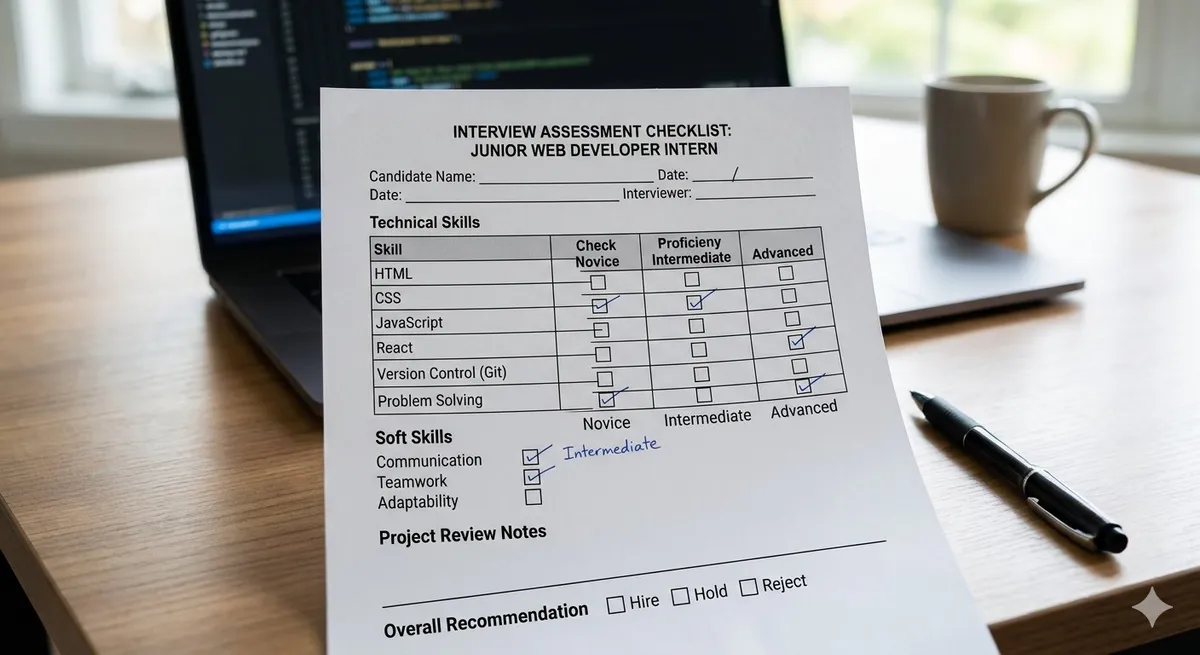
Not all coding ability is created equal. When you hire web developer interns, you’re evaluating potential alongside current skills. Look for candidates who demonstrate both technical competency and growth mindset.
Technical Skills to Evaluate
- Core web development languages: Proficiency in HTML, CSS, and JavaScript the absolute foundation. Candidates should build real projects, not just complete tutorials.
- Version control: Git and GitHub fluency shows professional practice and collaboration readiness. Review their public repositories.
- Front-end frameworks: React, Vue, or Angular experience is valuable but not always required strong fundamentals matter more than specific framework knowledge.
- Back-end capability: Familiarity with Node.js, Python, or similar languages, depending on your tech stack.
- Problem-solving approach: Present realistic coding challenges that reveal how candidates think, debug, and ask clarifying questions.
Non-Technical Qualities That Matter
The best interns combine technical foundation with interpersonal strengths: curiosity, communication clarity, coachability, and intrinsic motivation. During interviews, ask situational questions like “Tell me about a time you got stuck on a problem. How did you approach it?” Answers reveal whether candidates persevere, seek help appropriately, and learn from mistakes.
Structuring an Internship Program for Developers
The difference between an internship that produces real value and one that wastes everyone’s time comes down to intentional program design. Your internship program for developers should balance learning opportunities with meaningful contributions.
Duration and Timeline
Most effective internships run 10–16 weeks. This window provides enough time for onboarding, meaningful project work, and skill development, without requiring the full commitment of a permanent role. Summer internships align with academic calendars, while rolling internships can accommodate bootcamp graduates and career-changers year-round.
Mentorship and Onboarding Structure
Assign each intern a dedicated mentor ideally a mid-level developer who remembers the early-career perspective. Mentors should spend 5–10 hours weekly on structured guidance: pair programming, code review, architectural discussions, and career mentoring. This investment compounds through retention; interns who felt genuinely supported are far more likely to accept full-time offers or return for additional internships.
Create a structured onboarding checklist covering: development environment setup, codebase architecture overview, communication norms, deployment processes, and security practices. Don’t assume interns understand your specific workflows, even if they’re experienced with general concepts.
Project Assignments and Responsibility Progression
Week 1–2: Bug fixes, code cleanup, documentation updates low-stakes work that teaches your codebase and standards.
Week 3–8: Discrete feature development, small-to-medium components, isolated functionality. Interns should own complete projects from requirements through code review and deployment.
Week 9–16: More complex features, cross-team collaboration, technical documentation. By the end, interns should deliver shipping-quality code with minimal revision.
This progression ensures interns never feel overwhelmed while remaining genuinely productive. Modern web design and development practices evolve rapidly, so use projects as teaching opportunities for emerging technologies your team is adopting.
Remote Intern Positions: Managing Distributed Teams
If you’re recruiting remote intern positions, you’re accessing global talent but managing different challenges than co-located teams. Success requires explicit communication protocols and intentional connection-building.
Communication and Collaboration Tools
Establish clear preferences: Which platform for daily standups? Slack or email for quick questions? Where does documentation live? Remote interns need this scaffolding more than office-based peers who absorb culture through osmosis.
Implement twice-weekly synchronous check-ins one 1-on-1 mentor session and one team standup. These combat isolation and create accountability. Office hours (time blocks where mentors are available for questions) reduce intern anxiety about interrupting busy developers.
Time Zone Considerations
If your team spans multiple zones, find overlap windows for critical communication. Some companies hire remote interns exclusively from overlapping time zones. Others build asynchronous workflows where interns submit code review requests with detailed context so mentors can review during their business hours.
Be transparent about time zone differences in the job posting. Candidates appreciate honesty about whether they’ll have real-time collaboration or need to work independently.
Compensation, Benefits, and Legal Compliance
When you hire web developer interns, you must navigate wage laws, which vary by jurisdiction. In the U.S., unpaid internships are legal only if they meet specific Department of Labor criteria, but most tech internships should be paid.
Competitive Internship Compensation
Market rates for web developer interns in 2026 range from $18–28 per hour, depending on location, experience, and your company size. Startups might offer equity, while established firms offer hourly rates. Remote intern positions often command lower rates than on-site roles in high-cost areas, though this varies.
Beyond hourly pay, consider: health insurance (for longer internships), professional development stipends, and laptop provision. These benefits differentiate your program and show serious investment in intern success.
Tax and Legal Documentation
Work with HR and legal to ensure proper classification, tax withholding, and documentation. Different jurisdictions have different internship regulations. Non-U.S. hiring adds complexity; research visa and employment law requirements before recruiting abroad.
Our comprehensive guide on hiring web developers covers additional legal considerations that also apply to intern recruitment.
Evaluating Internship Program Success
How do you know your internship program is working? Track metrics that reveal both business impact and intern satisfaction:
- Intern-to-hire conversion rate: What percentage of interns convert to full-time roles? A healthy range is 40–70%.
- Project completion and quality: Did interns complete assigned projects? Did their code pass review and make it to production?
- Knowledge retention: Did interns demonstrate growing mastery of your tech stack and codebase?
- Mentor satisfaction: Did mentors feel the investment was worthwhile? Did they gain insights from teaching?
- Intern feedback: Would interns recommend your program to peers? What would they improve?
- Retention of hired interns: If interns become full-time employees, do they stay through the first year?
Use this data to refine your process each cycle. Programs improve when you actively gather feedback and iterate.

Common Pitfalls to Avoid When Hiring Web Developer Interns
Even well-intentioned programs stumble when companies ignore these common mistakes.
Treating interns as free labor: If you assign interns only tedious tasks with no learning value, they become resentful and perform poorly. Internships are investments in people, not shortcuts to cheap development.
Inadequate mentorship: Assigning an intern to a mentor who’s too busy to help defeats the program’s purpose. Mentorship requires time commitment and priority from leadership.
Ambiguous onboarding: Interns left to figure out your codebase and tools waste weeks. Structured, documented onboarding accelerates productivity dramatically.
Scope creep and burnout: As interns prove capable, teams sometimes load them with escalating responsibility beyond reasonable for a 10–16 week rotation. Protect intern workload; they’re still learning.
Ignoring diversity and inclusion: Internship programs often become homogeneous if you only recruit from selective universities or through existing networks. Actively source from bootcamps, community colleges, and underrepresented groups to build diverse pipelines.
Scaling Your Internship Program as Your Company Grows
If you start with one intern and want to expand to multiple cohorts, plan systematically. Document processes, create internship playbooks, train mentors formally, and assign someone to coordinate the program. As you scale, integrate your internship recruitment into broader hiring and talent strategies so it’s not disconnected from your company’s growth trajectory.
Next Steps: Building Your Web Developer Intern Program
Hiring web developer interns transforms your team’s capacity and creates lasting competitive advantage through talent development. The best time to build an internship program for developers was years ago; the second-best time is now.
Start small: recruit one or two interns, document your process, gather feedback, and iterate. Even a modest program properly structured with mentorship, meaningful projects, and competitive compensation yields significant returns through productivity gains, retention, and company culture strengthening.
If you’re ready to hire web developer interns but need guidance on scaling your development team or aligning technical hiring with your business strategy, contact Particular Angles today. Our team specializes in building development talent pipelines and internship programs that deliver real business results while developing the next generation of web development talent.
This guide was developed by the Particular Angles team based on practical experience in web design, web development, technical hiring, and team development. Our goal is to provide practical guidance for companies building or improving web developer internship programs.