




Last updated: October 6, 2026
How to Hire a Web Developer: Complete Guide for Small Businesses
Finding the right web developer can be the difference between a thriving online presence and wasted budget. Whether you’re launching your first website or rebuilding an existing one, understanding how to hire a web developer and knowing what to expect in terms of web developer salary, costs, and expertise is critical to your success. This guide walks small business owners through the entire hiring process, from defining your needs to evaluating candidates and making the final decision.
Hiring a web developer isn’t just about finding someone who can code. It’s about finding a partner who understands your business goals, can communicate technical concepts clearly, and delivers results that impact your bottom line. The stakes are high: according to HubSpot research, 38% of people will stop engaging with a website if the content or layout is unattractive, making quality web development an investment in revenue.

Understanding the Types of Web Developers You Can Hire
Before you start searching for candidates, it’s essential to understand the different types of web developers and how they approach projects. The choice between freelancers, agencies, and in-house developers will significantly impact your timeline, budget, and the final product quality.
Freelance web developers typically work independently and offer flexibility and often lower rates compared to agencies. They excel at smaller projects, quick turnarounds, and specialized tasks. However, freelancers may have limited availability, less accountability structure, and variable communication responsiveness.
Web development agencies bring established processes, teams of specialists, and accountability frameworks. Agencies are ideal if you need comprehensive services including design, development, and ongoing support. The trade-off is higher cost and potentially less personalized attention to your specific needs.
Freelance vs Agency: Key Differences
When deciding between custom web design vs templates and choosing who builds it, the freelance versus agency decision matters:
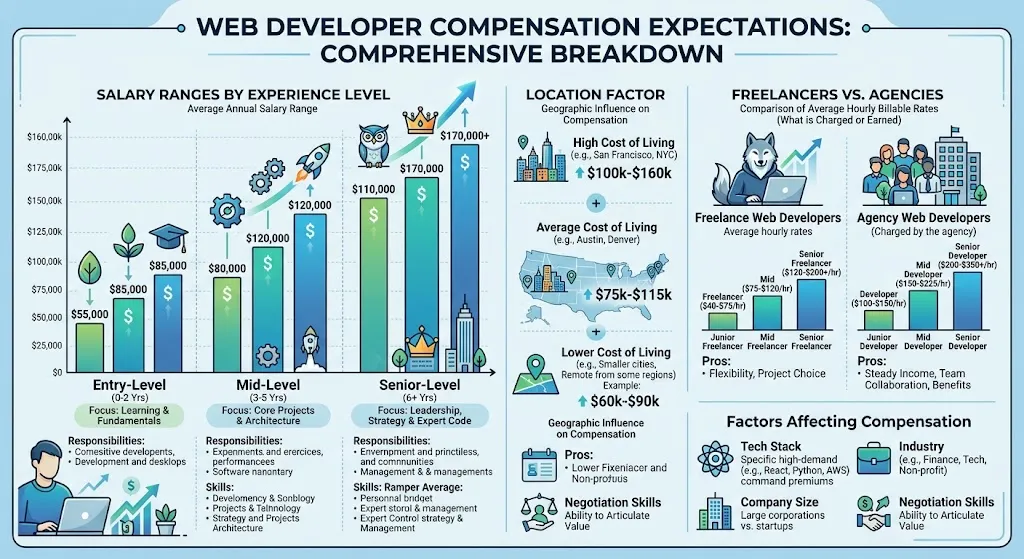
- Cost: Freelancers often charge $25–$150/hour; agencies typically charge $75–$300+/hour
- Timeline: Freelancers may work slower due to juggling multiple clients; agencies dedicate teams
- Communication: Direct contact with freelancers; account managers with agencies
- Quality Assurance: Freelancers self-manage; agencies have built-in QA processes
- Ongoing Support: Freelancers may be unavailable later; agencies offer maintenance packages
For most small businesses, a freelancer can be a good choice for a smaller website, a specific development task, or a limited budget. An agency may be a better option when the project requires web design, development, SEO, content, ongoing maintenance, or multiple specialists working together.
Before choosing either option, compare more than hourly rates. Consider the developer’s experience, communication process, availability, portfolio, project management approach, and post-launch support.
Understanding Web Development Cost and Salary Expectations
Understanding web developer salary ranges helps you budget appropriately and evaluate whether quoted rates are competitive or inflated. Web development costs vary dramatically based on experience level, location, technology stack, and project complexity.
According to the U.S. Bureau of Labor Statistics, the median annual wage for web developers was approximately $78,000 in 2024, though this varies by experience and geography. Entry-level developers earn $45,000–$60,000 annually, mid-level developers $70,000–$100,000, and senior developers with leadership responsibilities $110,000–$160,000+.
For small business hiring decisions, breaking down web development cost by project scope is more practical than annual salary:
- Simple brochure website: $3,000–$10,000
- Small business website with e-commerce: $10,000–$30,000
- Custom web application: $30,000–$100,000+
- Enterprise solution: $100,000–$500,000+
These figures reflect the reality that hiring developers involves both immediate project costs and potential long-term expenses for maintenance, updates, and feature additions. For context on broader digital strategy investment, explore how small business website design impacts revenue and justifies development expenses.
Key Skills and Credentials to Look For
Identifying the right skill set ensures your chosen developer can handle your project’s technical requirements and deliver code that scales. Different projects require different expertise, so align skill requirements with your specific needs.
Essential Technical Skills
Every capable web developer should demonstrate proficiency in:
- HTML, CSS, and JavaScript fundamentals
- At least one backend language (PHP, Python, Node.js, Java, C#)
- Version control systems (Git)
- Responsive design and mobile-first development
- Database management (SQL or NoSQL)
- Problem-solving and debugging
Specialized Skills Based on Project Type
Frontend specialists focus on user interface, user experience, and client-side functionality. They typically know React, Vue, or Angular frameworks. If you’re building a responsive, interactive web application, prioritize strong frontend credentials.
Backend developers handle server-side logic, databases, and API integration. They’re essential if your site needs e-commerce functionality, user authentication, or data processing. Backend expertise often comes with higher rates due to complexity.
Full-stack developers understand both frontend and backend, making them valuable for smaller projects where you need someone who can handle end-to-end development. However, their expertise may be broader but shallower than specialists.
Soft Skills That Matter
Technical ability alone doesn’t guarantee project success. Look for developers who demonstrate:
- Clear communication about technical concepts
- Willingness to explain their approach and reasoning
- Project management and time-tracking discipline
- Responsiveness to feedback and revisions
- Interest in your business goals, not just code
How to Start Hiring Developers and Vet Candidates
Once you understand your hiring needs and budget, the next step is finding qualified candidates. Multiple sourcing channels exist, each with distinct advantages and challenges when recruiting web developers.
Knowing how to hire a web developer also means knowing where to find qualified candidates and how to evaluate their experience before making a commitment.
Sourcing Channels
Freelance Platforms: Upwork, Toptal, and Gun.io connect you with vetted freelancers and agencies. Advantages include established feedback systems, escrow payment protection, and easy filtering by skills and rates. Disadvantages include platform fees, higher rates to cover fees, and less direct relationship building.
Direct Networking: LinkedIn, local tech meetups, and professional associations (like the Association for Computing Machinery) connect you with developers who can showcase deep expertise and local understanding. This channel often yields higher-quality candidates but requires more time investment.
Referrals: Asking other business owners, your accountant, or marketing consultant for developer recommendations provides social proof and reduces risk. Referral candidates typically prioritize quality to protect their recommender’s reputation.
Agencies: Full-service web design and development agencies offer comprehensive solutions and accountability. Review their portfolio, client testimonials, and case studies. How to hire a web design agency requires a more structured RFP process than hiring individual developers.
Evaluating Portfolios and Past Work
A strong portfolio reveals technical capability, design sensibility, and project scope experience. When reviewing a developer’s past work:
- Look for projects similar to your needs in complexity and industry
- Test website functionality: load times, mobile responsiveness, form submissions
- Review code quality indicators: clean navigation, accessibility features, security considerations
- Ask the developer to explain decisions made and challenges overcome on specific projects
- Check if past clients provided testimonials or case study participation
If a developer has limited portfolio pieces, ask for references from past clients and request a small test project before committing to a larger engagement.
The Interview Process: Questions to Ask
A structured interview reveals how a developer thinks, communicates, and approaches problem-solving. Use these questions to identify candidates aligned with your project and communication style.
Technical Questions
- “Walk me through your typical development workflow from project kickoff to launch.”
- “What’s your approach to responsive design and testing across devices?”
- “How do you handle security considerations in web applications?”
- “Describe a complex problem you solved recently and how you approached it.”
- “What tools and frameworks do you prefer, and why?”
Communication and Project Management Questions
- “How do you keep clients updated on project progress?”
- “What’s your process for handling scope changes or feature requests?”
- “How do you handle feedback that conflicts with your technical recommendations?”
- “What happens if you encounter an unexpected technical challenge during development?”
Business and Fit Questions
- “What types of projects energize you most?”
- “How do you stay current with new web development technologies?”
- “What’s your availability and how do you handle multiple client projects?”
- “What’s your policy on post-launch support and maintenance?”
The answers reveal not just technical capability but also work style, communication clarity, and genuine interest in your success. A developer who asks clarifying questions about your business goals is often more valuable than one who immediately proposes technical solutions.
Setting Clear Expectations and Contracts
Most hiring failures stem not from incompetence but from misaligned expectations. A clear contract protects both you and the developer while establishing professional boundaries.
Essential Contract Elements
Project Scope: Define exactly what will be built, including pages, features, integrations, and deliverables. Be specific: “responsive website” is vague; “5-page website with mobile-responsive design, contact form, and blog section” is clear.
Timeline and Milestones: Establish start date, project phases, and delivery deadlines. Include buffer time for revisions and approval cycles.
Payment Terms: Specify total cost, payment schedule (e.g., 50% upfront, 50% on delivery), and what triggers each payment. For ongoing work, establish hourly rates, monthly retainers, or fixed-fee arrangements.
Revision Policy: Clarify how many revision rounds are included before additional charges apply. This prevents endless back-and-forth.
Intellectual Property Rights: State who owns the final code, design files, and content. Typically, clients own everything upon full payment.
Communication Protocol: Define primary contact method, expected response times, and meeting schedules. Clear communication prevents misunderstandings.
Maintenance and Support: Specify what’s included post-launch: bug fixes, security updates, hosting support, or ongoing development.
Red Flags to Avoid When Hiring Web Developers
Certain warning signs indicate a developer may not be a good fit, regardless of technical credentials:
- Vague communication: Can’t clearly explain what they’ll do or how much it costs
- No portfolio: Claims experience but has no past work to show
- Unrealistic timelines: Promises complex projects in unreasonably short timeframes
- Unavailable for questions: Takes days to respond or seems dismissive of your concerns
- No mention of testing or QA: Quality developers systematically test their work
- Pressure to decide quickly: Legitimate developers aren’t desperate for your business
- No contract or terms: Professional developers always have written agreements
- Dismissive of your ideas: Good developers listen and explain trade-offs, not shut down conversations
Trust your instincts. If something feels off during initial conversations, it likely will during the project itself.
Making Your Final Decision
After interviewing multiple candidates, narrow your choice by weighing several factors beyond just cost. The cheapest developer isn’t necessarily the best value. Consider timeline, communication quality, relevant experience, and cultural fit with your business.
Request a small test project or proposal from your top two candidates. A detailed proposal shows how they think through problems and communicate technical approaches. This also reveals whether they understand your needs or are proposing cookie-cutter solutions.
Before signing a contract, verify references by asking past clients specific questions: Did they deliver on time? Was communication clear? Did the final product meet expectations? How responsive were they to issues after launch?
For long-term success, consider whether this developer could be a trusted partner for future projects. Web development and digital marketing alignment matters. A developer who understands how websites drive business results will make better technical decisions than one who focuses purely on code.

Onboarding Your New Web Developer
Once you’ve hired a developer, structured onboarding sets the stage for successful collaboration. Provide everything they need to hit the ground running.
Preparation Checklist
- Hosting account access and credentials
- Domain name registrar information
- Existing website access (if updating an existing site)
- Brand guidelines, logos, and brand colors
- Content in organized format (copy, images, videos)
- List of required integrations (payment processors, CRM, analytics tools)
- Sitemap showing page hierarchy and structure
- Competitor analysis or reference sites you admire
- Business goals and success metrics
The more organized you are going in, the faster development progresses and the fewer delays occur due to missing information.
Post-Launch Support and Long-Term Maintenance
Your relationship with a web developer shouldn’t end at launch. Websites require ongoing updates, security patches, and performance optimization. Establish a maintenance agreement covering:
- Monthly or quarterly security updates and backups
- Performance monitoring and optimization
- Bug fixes and issue resolution
- Minor feature updates or content changes
- Hosting and domain management
Many developers offer retainer packages ($300–$1,500/month) that include a set number of development hours for updates and maintenance. This is often more economical than paying per-incident rates and ensures your site stays secure and current.
Conclusion
Learning how to hire a web developer is one of the most impactful decisions for your small business’s digital presence. By understanding the types of developers available, setting clear expectations, evaluating candidates thoroughly, and establishing ongoing support, you’ll find a partner who delivers results.
The right web developer isn’t just a vendor. They’re an extension of your team who understands your business goals and creates solutions that drive revenue. Whether you choose a freelancer, agency, or in-house developer, invest time in the hiring process. The quality of your website directly impacts customer trust, conversion rates, and business growth.
Ready to move forward with hiring? Contact Particular Angles today to discuss your web development needs and discover how our team can build a custom solution that grows your business.
This guide was developed by the team at Particular Angles, a web design and development agency specializing in custom solutions for small businesses and tech startups. Our expertise spans responsive design, full-stack development, e-commerce integration, and digital strategy alignment. We’ve successfully guided dozens of businesses through the hiring process and delivered websites that measurably impact revenue and brand growth.