




Last updated: June 12, 2026
How to Integrate Digital Marketing with Web Development: 2026 Strategy
In today’s digital landscape, the line between web development and digital marketing has blurred entirely. Organizations that fail to integrate digital marketing with web development miss critical opportunities for conversion optimization, user engagement, and sustainable growth. Whether you’re launching a new website or revamping an existing digital presence, aligning your development and marketing teams is no longer optional—it’s essential.
This comprehensive guide walks you through actionable strategies for seamlessly merging your web development and digital marketing efforts, ensuring every line of code serves both technical excellence and marketing objectives.
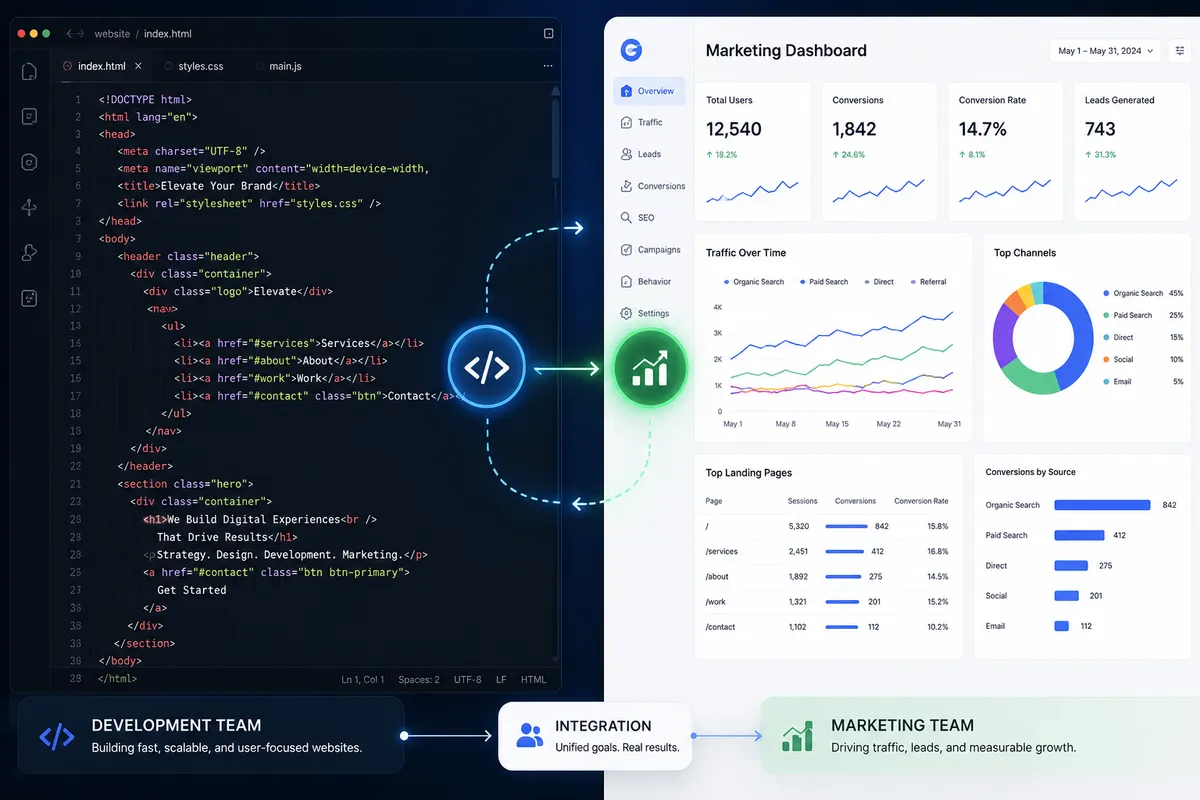
Why Integrating Digital Marketing and Web Development Matters
The relationship between web development and digital marketing strategy has become inseparable. According to Statista research on user engagement metrics, websites optimized for both performance and conversion generate 40% higher user retention rates. When development teams and marketers operate in silos, you risk building technically sound websites that fail to convert visitors into customers.
Integration ensures that your website architecture, page speed, user experience, and content strategy all work harmoniously toward business goals. Your site becomes a true asset for customer acquisition and retention rather than simply a digital placeholder.
Real-world example: E-commerce platforms that align their development roadmap with marketing campaigns see 35% faster time-to-market for promotional features and significantly improved customer lifetime value.
Core Principles for Combining Web Development and Marketing Efforts
Establish Shared Goals and Metrics
Before any integration can succeed, both teams must define shared success metrics. These might include page load time, conversion rate, cost per acquisition, or engagement depth. When developers understand that a 1-second page delay reduces conversions by 7%, they prioritize performance optimization differently.
Create a unified dashboard where both teams monitor KPIs in real-time. This transparency builds accountability and enables rapid iteration when performance falls short.
Design with User Intent in Mind
Web development marketing strategy succeeds when every design decision considers user intent. This means developers should understand your buyer personas, customer journey stages, and conversion paths before writing a single line of code.
Conduct joint workshops where marketing shares audience research and developers discuss technical constraints. This collaborative approach prevents costly rewrites and ensures the final product truly serves user needs.

Technical SEO: Where Development and Marketing Converge
Technical SEO is perhaps the most critical intersection of web development and digital marketing. According to Moz’s comprehensive SEO guide, technical factors account for approximately 25-30% of ranking factors that Google considers.
Essential Development Components for Marketing Success
Your development team must implement:
- Core Web Vitals optimization—Largest Contentful Paint, First Input Delay, and Cumulative Layout Shift directly impact search rankings and user experience
- Mobile-first architecture—Over 60% of web traffic comes from mobile devices; responsive design is non-negotiable
- Structured data markup—Schema.org implementation helps search engines understand your content and enables rich snippets
- XML sitemaps and robots.txt—Proper crawlability ensures search engines index all valuable pages
- SSL/HTTPS security—Google ranks secure sites higher; this also builds user trust
Content Architecture and Keyword Integration
Developers should build websites with flexible content management systems that allow marketers to optimize for target keywords without constant developer intervention. Your full-stack marketing approach requires CMS flexibility, customizable meta tags, URL structure optimization, and heading hierarchy support.
Implementing Full-Stack Marketing Through Development Choices
Full-stack marketing means every technology decision supports marketing objectives. From your hosting infrastructure to your JavaScript framework, development choices cascade through your entire marketing operation.
Analytics and Tracking Infrastructure
Marketers need robust tracking to understand customer behavior, but developers must implement it correctly. Poor tracking implementation wastes data and creates security vulnerabilities.
Work together to:
- Choose a unified analytics platform your entire team understands
- Implement event tracking for all critical user actions before launch
- Establish data governance policies that respect user privacy while enabling marketing insights
- Create custom dashboards that answer specific business questions
Conversion Rate Optimization Built Into Development
Rather than bolting CRO onto a finished website, embed optimization into the development process. This means A/B testing frameworks, heat mapping capabilities, and form analytics should be architected from the start.
Your development team should build flexible page templates that marketers can test without constant code changes. This dramatically accelerates experimentation cycles and compounds optimization gains over time.

Tool Stack: Bridging Development and Marketing Platforms
Modern organizations use integrated platforms that facilitate collaboration between development and marketing teams. Your chosen tools should enable:
- Version control and deployment pipelines (GitHub, GitLab)
- Content management with marketing-friendly interfaces (Webflow, Contentful)
- Analytics and user behavior tracking (Google Analytics 4, Mixpanel)
- Marketing automation (HubSpot, Marketo)
- A/B testing and personalization (Optimizely, VWO)
- Project management and communication (Jira, Slack)
The key is eliminating manual data transfers between systems. API integrations and native platform connections ensure both teams work with current information.
Building Cross-Functional Teams for Digital Marketing Web Design
Integration requires structural changes beyond tools and processes. Organizations succeeding with digital marketing web design typically employ cross-functional teams with shared ownership of outcomes.
Define Clear Ownership and Responsibilities
While collaboration is essential, ambiguous ownership creates bottlenecks. Establish clear decision-making frameworks:
- Developers own technical implementation and performance
- Marketers own messaging, positioning, and conversion strategy
- Product managers own overall user experience and feature prioritization
- All parties collaborate on decisions affecting multiple domains
Regular Communication Cadences
Schedule recurring meetings that keep teams aligned without creating meeting fatigue. A weekly 30-minute sync focusing on blockers and progress typically suffices. Monthly deep-dives allow for strategic planning and retrospectives.
Measuring Success: Integration ROI and Performance Metrics
How do you know your integration efforts are working? Establish baseline metrics before any integration initiative and track progress quarterly.
Key performance indicators include:
- Time-to-campaign-launch—Reduced time between marketing concept and live execution
- Conversion rate improvement—Higher percentage of visitors converting to customers
- Cost per acquisition—Efficient customer acquisition through optimized digital properties
- Page load time and Core Web Vitals—Technical performance improvements
- Team velocity and satisfaction—How effectively teams collaborate and deliver
Document case studies from your integration efforts. Perhaps a streamlined checkout flow (development + marketing collaboration) increased conversion by 12%. Or maybe rapid testing capabilities (CRO infrastructure) improved email click-through rates by 8%. These wins build internal momentum for continued investment.
Common Integration Pitfalls and How to Avoid Them
Even well-intentioned integration efforts fail without awareness of common challenges:
- Misaligned incentives—If developers are rewarded for bug-free code and marketers for conversions, conflict emerges. Align compensation and performance reviews around shared metrics.
- Insufficient communication infrastructure—Tools alone don’t create understanding. Invest in documentation, wikis, and knowledge-sharing practices.
- Technology decisions made in isolation—A developer choosing a framework without marketing input can cripple marketing flexibility. Involve all stakeholders in major decisions.
- Treating integration as one-time project—Sustained integration requires ongoing culture and process investment, not just a quarterly initiative.
Looking Ahead: 2026 Trends in Web Development and Digital Marketing Integration
The convergence of web development and digital marketing continues accelerating. Emerging trends include AI-powered personalization integrated directly into development frameworks, voice search optimization baked into content architecture, and predictive analytics informing development roadmaps.
Organizations that master the art of integrating digital marketing with web development will build more resilient, customer-centric digital properties that compound advantages over time.
Getting Started: Your Integration Action Plan
Ready to align your development and marketing efforts? Begin with these immediate steps:
- Schedule a workshop bringing developers, marketers, and product leaders together
- Audit your current tech stack for integration gaps and data silos
- Define three shared success metrics your teams will optimize together
- Establish a recurring communication cadence and communication norms
- Identify one quick-win project to demonstrate integration benefits
The integration of digital marketing with web development isn’t a luxury or nice-to-have—it’s the foundation of modern, competitive digital strategy. Organizations that align these critical functions gain measurable advantages in speed, efficiency, and customer results.
Ready to transform your digital capabilities? Contact Particular Angles today to develop a customized integration strategy for your organization. Our team combines deep development expertise with marketing mastery to help you build seamless, high-performing digital experiences.
About the Author: This article was developed by the strategy team at Particular Angles, a digital agency specializing in aligning web development and marketing efforts for B2B and B2C organizations. With over 15 years of combined experience in both disciplines, our team understands the critical intersection of technical excellence and marketing effectiveness. We’ve guided 200+ companies through successful digital transformation initiatives.