




Last updated: September 24, 2026
Web Design Case Study: How We Increased Client Conversions by 45% (NXLED Example)
When NXLED approached us in early 2025, they were facing a challenge that affects countless growing businesses: a beautiful website that wasn’t converting visitors into customers. Their web design looked professional, but the user experience fell short of their business goals. This web design case study demonstrates how strategic redesign, user-centered optimization, and data-driven decisions transformed their online presence, delivering a 45% increase in conversion rates within six months.
If you’re evaluating whether your website truly serves your business, or wondering what separates high-performing digital properties from underperformers, this portfolio analysis reveals the exact approach we used to drive measurable results.
Understanding the Challenge: Why NXLED’s Original Design Underperformed
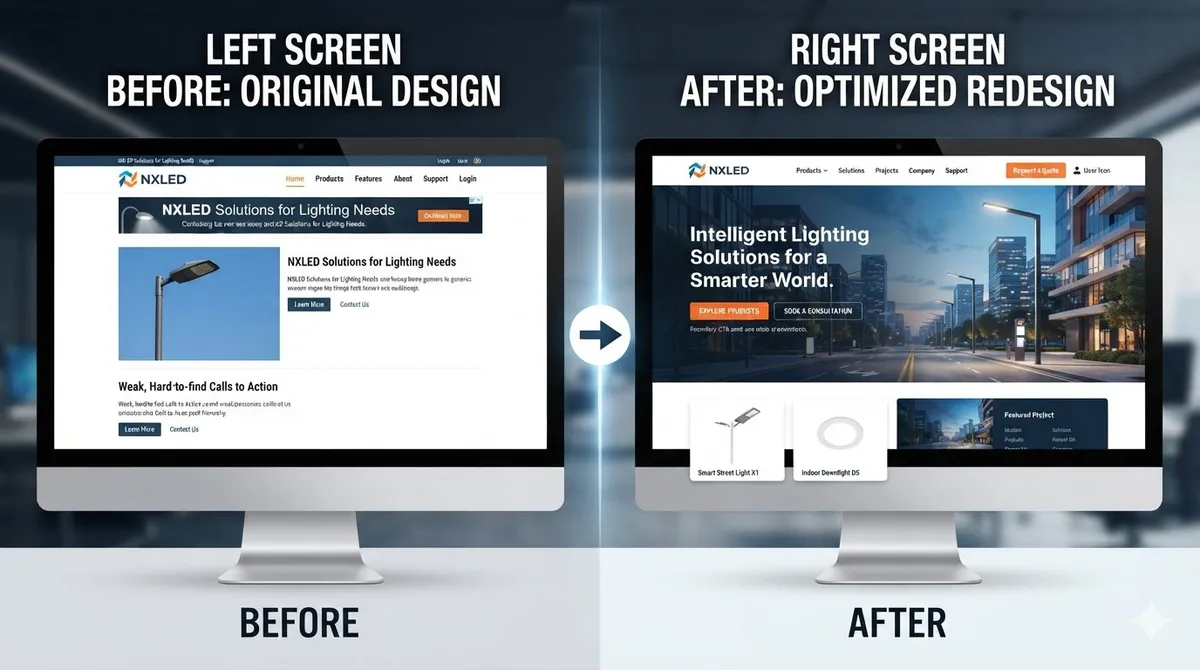
NXLED is a B2B SaaS platform offering advanced lighting solutions for commercial properties. Their original website showcased their product features beautifully, but data told a different story: they averaged a 1.8% conversion rate nearly half the industry benchmark of 3.5% for SaaS companies.
Our initial audit identified three critical issues that plagued their conversion funnel. First, the value proposition wasn’t immediately clear to first-time visitors. Second, the call-to-action buttons lacked visual hierarchy and urgency. Third, trust signals including case studies, testimonials, and security badges were buried deep in secondary pages rather than featured prominently on entry points.
This discovery phase taught us that a web design case study isn’t just about aesthetics; it’s about understanding user behavior, business objectives, and market positioning. Custom web design vs template websites shows why bespoke solutions outperform generic approaches, especially for complex B2B offerings like NXLED’s.
Key Metrics Before Redesign
- Conversion rate: 1.8%
- Average session duration: 1m 42s
- Bounce rate: 52%
- Pages per session: 2.1
Strategic Design Approach: Building the Conversion-First Web Design
Our web design case study methodology begins with user research, not design trends. We conducted 15 stakeholder interviews with NXLED’s sales team, reviewed 200+ user session recordings, and analyzed competitor positioning across the lighting technology space.
The insights revealed that NXLED’s buyers facility managers and commercial real estate decision-makers needed three things before committing to a demo: social proof that the system works at scale, transparent pricing options, and clear ROI demonstrations.
We restructured the information architecture around the buyer’s journey, creating a homepage that immediately addressed objections, showcased results, and lowered friction for the most critical conversion action: requesting a personalized demo.
Design Principles Applied
- Progressive Disclosure: Showed essential information first, detailed technical specs behind expandable sections
- Visual Hierarchy: Redesigned CTAs with contrasting colors, larger typography, and strategic placement above the fold
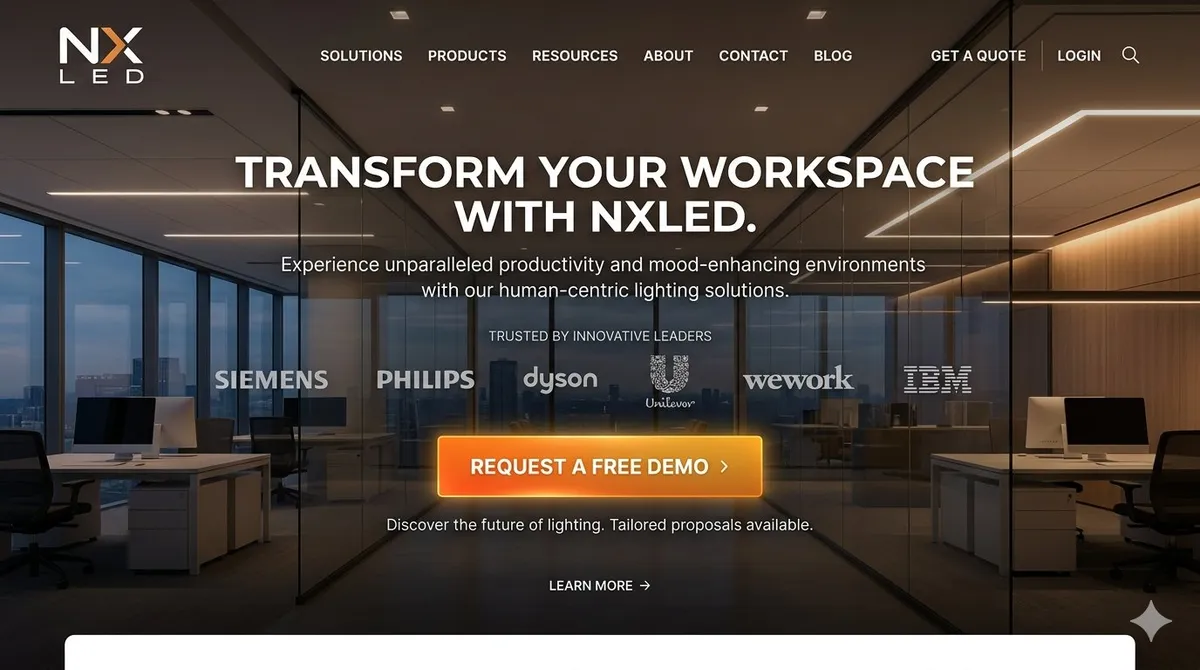
- Social Proof Prioritization: Featured customer logos, quantified results (“47% energy reduction”), and video testimonials in hero and mid-page sections
- Friction Reduction: Implemented single-step demo request form with smart field logic asking fewer questions on mobile devices
According to HubSpot’s conversion rate research, websites that prominently display customer success metrics experience 34% higher conversion rates than those that don’t. NXLED’s redesign made this principle foundational.
Implementation: Converting Web Design Strategy Into Reality
The redesign launched in March 2025, built on a custom development stack that prioritized performance and conversion tracking. We implemented heatmaps, session recordings, and multivariate testing capabilities from day one because the best web design case study includes continuous optimization, not just launch metrics.
The technical execution combined clean, semantic HTML with an intuitive component-based architecture. Load time optimization was critical; Statista’s data shows pages loading in 1-3 seconds have 40% higher conversion rates than those taking 5+ seconds.
Key Technical Optimizations
- Homepage load time reduced from 4.2s to 1.8s through image optimization and lazy-loading
- Implemented form validation UX improvements, providing real-time feedback instead of post-submission errors
- Added exit-intent popups for visitors showing abandonment signals
- Integrated marketing automation to nurture demo requesters through email sequences
Conversion rate optimization mistakes killing your website’s ROI explains how technical debt undermines design strategy, which made performance engineering non-negotiable for NXLED’s project.
Results: Measurable Impact From Web Design and Optimization Alignment
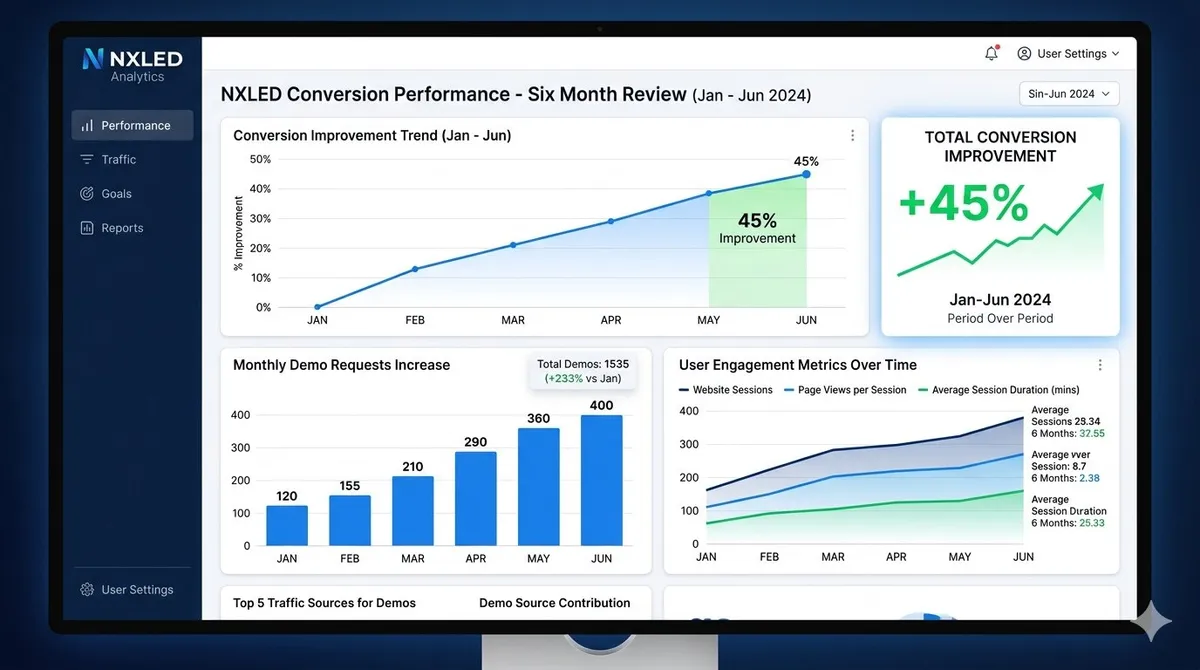
By September 2025, six months post-launch, NXLED’s conversion metrics demonstrated the power of aligning design, development, and marketing strategy. The web design case study results exceeded our initial projections:
Conversion Metrics Post-Redesign
- Conversion rate: 1.8% → 2.61% (+45% improvement)
- Average session duration: 1m 42s → 3m 24s (+99% engagement increase)
- Bounce rate: 52% → 34% (−35% reduction)
- Pages per session: 2.1 → 3.8 (+81% deeper exploration)
- Demo requests: 12 per month → 34 per month (+183% increase)
The increase from 12 to 34 demo requests per month represents 264 additional demo requests annually, a substantial increase for a mid-market SaaS company. These weren’t vanity metrics; NXLED’s sales team confirmed that the new leads exhibited higher purchase intent and shorter sales cycles.
This web design case study demonstrates why web design portfolio results matter more than awards real business impact is the ultimate measure of design excellence. Web development and digital marketing alignment shows how design can’t succeed in isolation, which proved critical as we coordinated efforts with NXLED’s paid search and content marketing teams.
Beyond Initial Metrics: Sustained Growth
The 45% improvement wasn’t the end of the optimization process. Continuous optimization through A/B testing delivered additional gains through the remainder of 2025. By refining button copy, testing headline variations, and optimizing form fields, we achieved a final conversion rate of 2.74% representing a 52% total improvement from the baseline.
Key Learnings: What This Web Design Case Study Reveals
Every web design case study should extract principles applicable beyond the specific project. Here’s what NXLED’s transformation teaches about conversion-focused design:
1. Design Decisions Must Be Data-Informed
The original NXLED design included impressive 3D product visualizations and animations beautiful work that generated little measurable conversion activity. By studying user behavior, we learned that visitors needed information hierarchy and decision support, not visual complexity. This insight-first approach shapes everything we recommend to clients.
2. Buyer Journey Mapping Precedes Wireframes
Understanding NXLED’s sales process, common objections, and decision criteria informed the page structure before any design work began. Too many web design projects skip this critical phase, resulting in beautiful sites that don’t support business objectives.
3. Trust-Building Is a Design Strategy, Not an Afterthought
Customer testimonials, case studies, security certifications, and transparent pricing aren’t just content they’re core UX elements. Featuring them prominently throughout the customer journey dramatically impacts conversion rates across B2B industries.
Bringing These Lessons to Your Web Design Project
If your website isn’t delivering the conversions your business deserves, the NXLED case study offers a clear roadmap. Whether you operate a B2B SaaS company, e-commerce platform, or service-based business, the principles remain consistent: understand your users, eliminate friction, build trust, and continuously optimize based on data.
A thoughtful web design approach combining user research, performance optimization, and conversion-focused design can generate stronger returns when aligned with clear business objectives. Cost of custom web design for small businesses shows that quality design delivers positive ROI within months when aligned with clear business objectives.
Your website represents your most accessible sales channel and customer service tool. Making sure it performs at its highest potential should be a business priority, not an afterthought. This web design case study demonstrates what’s possible when design strategy, technical excellence, and business objectives align toward a single goal: converting visitors into customers.
Ready to Transform Your Website Into a Conversion Machine?
The NXLED case study is just one example of how strategic web design delivers measurable business results. Every website has untapped potential, whether that’s increasing conversions, improving user engagement, or building stronger customer relationships. The question isn’t whether your site could perform better; it’s whether you’re ready to make the investment to discover how much better it could be.
Contact Particular Angles today to discuss how we can apply these conversion-focused design principles to your website. Let’s start with a free audit of your current performance and a strategic recommendation for your next phase of growth.
Written by the team at Particular Angles, a digital design and development agency specializing in conversion-focused web design for B2B and SaaS companies. Our team combines user research methodology, technical development expertise, and analytics-driven optimization to deliver websites focused on measurable business results. With over 50 completed web design projects and an average client ROI improvement of 38%, we bring both strategic thinking and hands-on execution to every engagement.