




Last updated: September 4, 2026
Web Developer Intern Hiring: What to Look for and Where to Find Talent
Finding the right web developer intern can transform your team’s productivity and bring fresh perspectives to your projects. Whether you’re a startup, agency, or established company, web developer intern hiring requires a strategic approach that balances technical competency with growth potential. This guide walks you through identifying top talent, evaluating candidates effectively, and building a hiring process that attracts motivated junior developers ready to contribute meaningfully to your organization.
The demand for web development talent continues to surge. According to the U.S. Bureau of Labor Statistics, employment of web developers and digital designers is projected to grow 5% from 2025 to 2035, faster than the average for all occupations. The right intern becomes a trained asset who understands your code, your team culture, and your client expectations.
Understanding What You Actually Need in an Intern
Before posting a job description or scouring LinkedIn, define what “success” looks like for your internship role. This clarity shapes every downstream decision: where you advertise, what skills you prioritize, and how you evaluate candidates. Too many companies rush into hiring without this foundational work, resulting in mismatched expectations and underutilized talent.
Start by identifying the specific projects or workflows where an intern will contribute. Will they focus on front-end development using React and Vue? Will they handle WordPress customizations? Will they assist with full-stack applications? The technical stack determines the skill set you should target. A complete guide to hiring web developers covers senior roles in detail, but interns require a different lens: growth trajectory matters as much as current capability.
Defining Core Competencies vs. Nice-to-Have Skills
Create two lists. Core competencies—such as HTML, CSS, JavaScript fundamentals, or Git version control—are non-negotiable. Nice-to-have skills—familiarity with specific frameworks, design tools, or marketing knowledge—become tiebreakers between otherwise equal candidates.
Many hiring managers inflate skill requirements, demanding 5 years of experience from someone applying for an entry-level role. This filters out exactly the talent you want to develop. Instead, assess baseline understanding and demonstrated willingness to learn. A student who’s completed rigorous coding bootcamp coursework often outpaces a candidate with sporadic self-taught dabbling.
Building Your Junior Developer Job Description
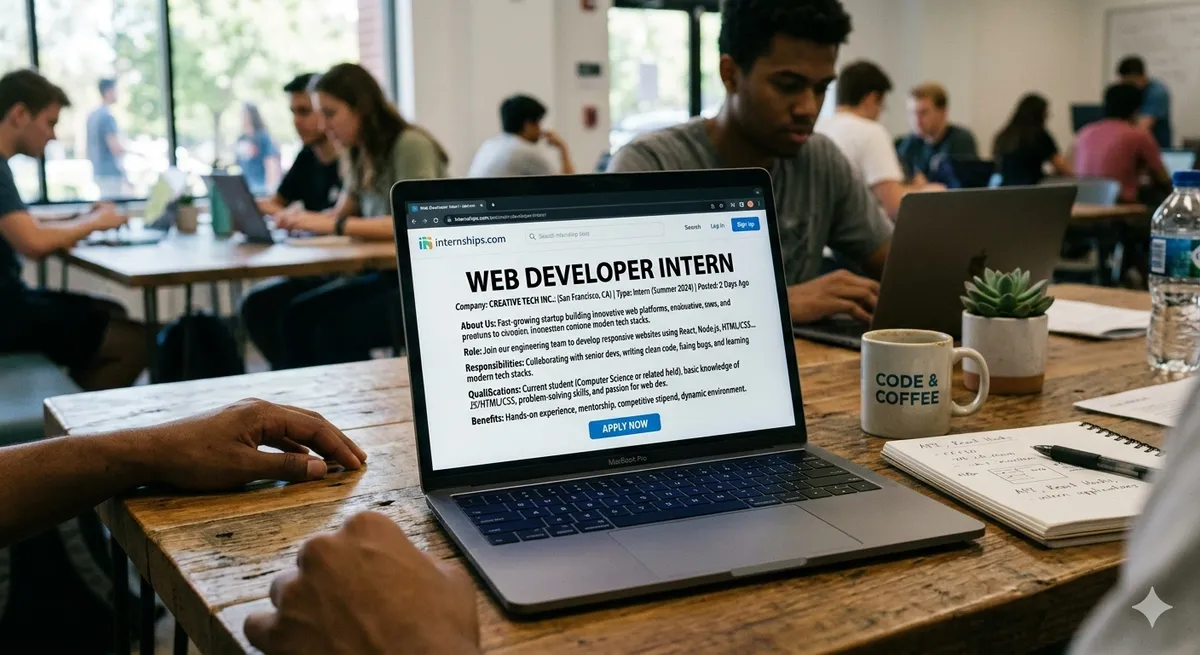
A strong junior developer job description attracts qualified candidates and filters out time-wasters. It should be clear, honest, and specific about learning opportunities alongside responsibilities. Interns expect structured guidance; candidates applying for internships are choosing education alongside income.
What to Include in Your Posting
Start with a compelling summary: “We’re seeking a web development intern to join our team for a 12-week paid internship, where you’ll build real client projects, learn modern web standards, and collaborate with experienced developers.” This immediately sets expectations.
Then specify:
- Technical Requirements: “Proficiency in HTML, CSS, and JavaScript; familiarity with React preferred but not required”
- Responsibilities: “Develop responsive web pages, assist in debugging client sites, contribute code reviews with senior developers, attend weekly learning sessions”
- Duration & Compensation: Be explicit. “12-week paid internship, $18-22/hour, hybrid schedule (3 days in-office, 2 remote)”
- Learning Outcomes: “By the end of this internship, you will have deployed 3+ live websites, mastered Git workflows, and built a professional portfolio”
- Application Instructions: Request a GitHub profile, portfolio link, or coding sample—not just a resume
Avoid vague language like “fast-paced environment” or “self-starter.” These clichés tell candidates nothing about daily work. Instead, say: “You’ll typically handle 2-3 project tasks per week while pairing with senior developers for complex problems.”
Where to Find Web Developer Intern Talent
The best candidates aren’t always on Indeed or LinkedIn. They’re on GitHub, building projects for portfolio value rather than paychecks. They’re in Discord communities, answering questions to reinforce their learning. They’re in coding bootcamp final-project showcases. Strategic sourcing multiplies your candidate pool quality.
Online Platforms & Communities
GitHub: Search for repositories matching your tech stack. Look for consistency: multiple projects, clear documentation, recent commits, and thoughtful commit messages. These signals indicate serious learners.
Dev.to & Hashnode: Developers publishing blog posts about their learning journey demonstrate communication skills and deep engagement with their craft. Many are active in their platforms’ communities.
Coding Bootcamp Networks: Partner with local bootcamps like General Assembly, Flatiron School, or Springboard. They maintain alumni networks and often host job fairs. Bootcamp graduates have recent training in modern stacks and proven commitment (they invested time and money).
University Computer Science Programs: Reach out to CS department career services offices. Professors often recommend top students. You’ll find candidates closer to your level of expertise and geographic preferences.
Reddit & Discord: Communities like r/learnprogramming, r/webdev, and servers like Coding Garden have thousands of engaged developers. Post thoughtfully (no spam), and quality applicants will reach out organically.
Building Your Talent Pipeline
Don’t wait until you need an intern. Build relationships year-round. Sponsor a booth at tech meetups. Offer workshops on web development fundamentals. These activities position your company as an employer that invests in junior talent, making your internship postings more attractive when you share them.
According to HubSpot’s Hiring State of Play report, 82% of talent acquisition leaders agree that building talent pipelines reduces time-to-hire by an average of 40%. Early nurturing of relationships with junior developers pays measurable dividends.
Your Web Developer Intern Hiring Process
An effective intern hiring process balances rigor with accessibility. Interns shouldn’t jump through the same hoops as senior hires, but the process should confirm they can contribute meaningfully and thrive in your environment.
Step 1: Review Portfolio & Technical Samples
Request GitHub links, portfolio websites, or code samples in the application. Spend 15 minutes evaluating their best work. You’re not looking for perfection; you’re assessing:
- Can they write readable code with clear variable names?
- Do they use version control (Git commits with thoughtful messages)?
- Is there evidence of debugging and problem-solving?
- Do projects have README files documenting how to run them?
Candidates without a portfolio? Ask them to build a simple project (a to-do app, weather widget, or personal portfolio site) and submit it. This removes excuses and filters for initiative.
Step 2: Phone Screen (20-30 minutes)
Confirm soft skills and gauge communication ability. Ask open-ended questions: “Tell me about a project that challenged you. What went wrong and how did you solve it?” Listen for problem-solving thinking, not just technical knowledge.
Discuss your role’s specific tech stack. “We primarily use React and Next.js. What’s your experience with React?” Honest answers matter more than expertise. A candidate saying “I’ve completed React tutorials but haven’t built a production app yet” is often more reliable than one overstating abilities.
Step 3: Practical Technical Assessment
Use a take-home coding challenge or a live coding session. For interns, keep it reasonable: a 1-2 hour take-home challenge building a component or fixing buggy code is more fair than a 4-hour marathon. Live coding on a whiteboard or shared editor works too; gauge how they approach unfamiliar problems, ask clarifying questions, and break down solutions—not just whether they arrive at the “right” answer.
Step 4: Team Interview
Have the candidate meet 2-3 team members (a senior dev, someone in HR/leadership, and ideally someone close to their peer level). This reveals culture fit and gives your team a voice in the decision. Spend less time on technical deep-dives (you’ve already assessed this) and more on work style, communication, and values alignment.
What to Look for Beyond Technical Skills
This is where many hiring managers falter. A candidate with perfect technical skills but poor communication or growth mindset often underperforms compared to a solid coder who listens, asks questions, and adapts quickly.
Growth Mindset & Coachability
Ask behavioral questions revealing mindset: “Tell me about a time you failed. What did you learn?” or “Describe a situation where someone gave you critical feedback. How did you respond?” Candidates demonstrating self-awareness and desire to improve are gold. Interns especially need this trait; you’re investing in their development, not just their current output.
Communication Skills
Can they explain technical concepts clearly? Ask them to walk you through a project or recent learning. Do they use jargon defensively or explain concepts accessibly? Strong communication separates developers who collaborate effectively from isolated code-writers. For interns working alongside experienced developers, this is crucial.
Curiosity & Initiative
Have they taken learning beyond assigned coursework? Do they contribute to open source? Read tech blogs? Attend meetups or conferences? These behaviors indicate intrinsic motivation, which matters more for interns than external credentials.
Hiring web developers in 2026 requires understanding that the landscape values demonstrated ability and potential alongside certifications. Interns who show curiosity often outpace peers with more formal qualifications.

Building an Effective Onboarding & Mentorship Plan
Hiring is just the beginning. Intern success depends on structured onboarding and active mentorship. Before day one, prepare documentation: coding standards, project setup guides, and a learning roadmap. Assign a primary mentor—someone willing to spend 3-5 hours weekly on guidance, code review, and career advice.
During their first week, have interns set up development environments, review your codebase architecture, and complete a small first project (like fixing a minor bug) with close mentorship. This ramps them toward independence while keeping them engaged and reducing startup friction.
Weekly check-ins matter. Ask: “What are you learning? What’s blocking you? Where can we provide better support?” Adjust responsibilities as they grow. An intern writing only static HTML in week two should own full components by week eight.
Key Takeaways for Successful Web Developer Intern Hiring
Effective web developer intern hiring requires clear role definition, strategic sourcing, a balanced evaluation process, and genuine mentorship commitment. You’re not just filling a position; you’re developing future talent—talent that might become your next senior developer or valuable team member.
Start by auditing your needs. Craft honest job descriptions. Source from diverse channels including GitHub, bootcamps, and communities. Design a reasonable evaluation process. Prioritize growth mindset alongside technical skills. Commit to structured mentorship.
The best companies don’t hire interns when they desperately need capacity. They hire interns because they’re building a talent machine, developing junior developers into seasoned professionals who understand their code, their culture, and their clients. That investment compounds over years.
If you’re ready to build a web development team that includes strong junior talent, or you need guidance refining your hiring process, contact Particular Angles today. We’ve helped dozens of agencies and companies develop effective hiring strategies and build teams that deliver exceptional client results. Let’s discuss your specific hiring goals and build a plan that works.
Authored by the team at Particular Angles, a web development and digital marketing agency specializing in building high-performing teams and delivering results-driven websites. With over a decade of experience hiring, mentoring, and developing web development talent, we understand what separates exceptional interns from the rest. Our insights come directly from managing internship programs, interviewing hundreds of candidates, and watching junior developers grow into senior contributors.