




Last updated: November 6, 2026
Conversion-Focused B2B SaaS Web Design Strategies for 2026
The landscape of B2B SaaS web design continues to evolve rapidly as buyers demand faster, more intuitive experiences and conversion optimization becomes non-negotiable. In 2026, SaaS website design has shifted from flashy aesthetics to purposeful, data-driven interfaces that guide users toward action while building trust with enterprise decision-makers. Whether you’re launching a new platform or redesigning an existing one, understanding these B2B web design trends isn’t just nice; it’s essential for competing in an increasingly crowded market.
This guide explores the most impactful B2B SaaS design strategies driving conversions today. You’ll discover how leading companies use progressive disclosure, intent-based CTAs, and visual hierarchy to turn prospects into customers while improving usability and building trust.
Conversion-focused B2B SaaS web design combines clear messaging, intuitive navigation, and strategic calls to action to help turn website visitors into potential customers.

B2B Web Design Trends 2026: Why SaaS Websites Need a New Approach
SaaS product interfaces have matured significantly, and buyer expectations have followed suit. Website design plays an important role in shaping how B2B decision-makers evaluate a company’s credibility, usability, and overall value. This means your SaaS website design isn’t just a marketing tool; it’s a sales instrument.
The shift in 2026 reflects three core changes: first, faster load times and mobile-first design are now table stakes, not differentiators. Second, personalization and progressive profiling are increasingly used to create more relevant buyer experiences. Third, conversion-focused design has replaced generic “look professional” aesthetics.
Modern B2B web design trends emphasize clarity over complexity. Prospects researching SaaS solutions spend minimal time decoding jargon or navigating cluttered layouts. Instead, they scan for proof points, pricing transparency, and a clear path to a free trial or demo.
Key Conversion-Focused B2B SaaS Design Elements That Drive Results
Building a high-converting SaaS website requires intentional design choices across several critical areas. These elements work together to reduce friction and guide prospects toward action.
1. Intent-Based Above-the-Fold Messaging
Your hero section must answer the prospect’s core question: “Why should I care?” Rather than describing your product, state the specific outcome it delivers. Instead of “Cloud-based project management software,” try “Improve team collaboration and streamline project delivery with transparent workflows.” A/B testing can help identify which outcome-focused headlines encourage more clicks on B2B SaaS landing pages.
2. Trust Signals and Social Proof
Enterprise buyers need assurance before signing up. Include customer logos (particularly recognizable brands), certifications (SOC 2, ISO 27001), and specific case study results. B2B SaaS prospects often review peer feedback and case studies before contacting a sales team. Position these elements strategically around your primary CTA.
3. Progressive Disclosure and Simplified Navigation
B2B SaaS websites often suffer from information overload. Use progressive disclosure, which reveals details only when users request them, to maintain clarity. Tab-based feature comparisons, expandable sections, and contextual tooltips reduce cognitive load while keeping comprehensive information accessible.
Modern Visual Design Patterns That Resonate with Enterprise Buyers
Visual hierarchy and design consistency directly impact both user experience and conversion rates. In 2026, successful B2B SaaS web design balances professional aesthetics with functional clarity.
Conversion-focused SaaS design combines visual clarity, consistent branding, and intuitive navigation to help visitors understand a product and take the next step.
Conversion-Focused SaaS Design: Minimalism Meets Functionality
Many modern SaaS websites favor ample whitespace, restrained color palettes, and readable typography over unnecessary visual effects. Instead, they use ample whitespace, a restricted color palette (typically 3-4 core colors), and typography that prioritizes readability. This approach reduces bounce rates and increases time-on-page engagement.
Data Visualization and Product Showcase
Rather than listing features, show them. Interactive demos, animated dashboards, and video walkthroughs let prospects experience your B2B SaaS web design in action. Interactive elements, such as product demos and video walkthroughs, can give visitors a clearer understanding of a product than static screenshots alone.
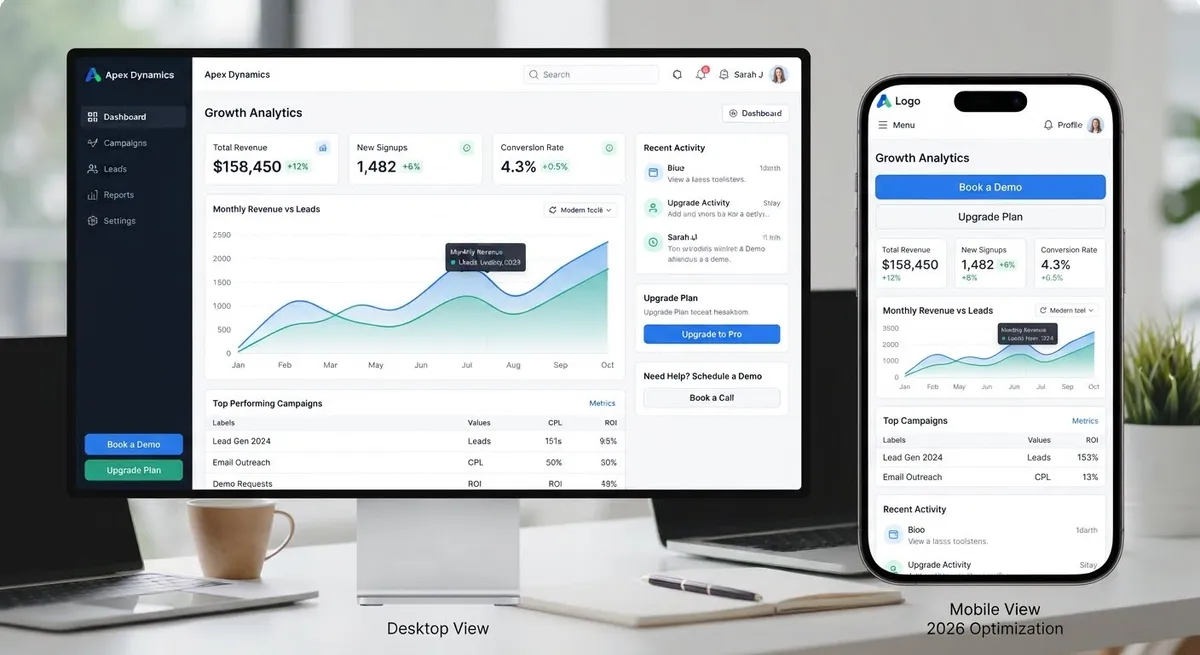
Mobile-First Design Architecture
For mobile visitors, keep demo request buttons easy to find, use short forms with clearly labeled fields, and make buttons large enough to tap comfortably. Test the complete sign-up and demo request experience on different screen sizes to identify usability issues before launch.
Many B2B SaaS buyers use mobile devices to research products and services, making responsive design essential. True mobile-first design means structuring your information hierarchy for small screens first, then expanding for larger displays. This ensures core CTAs, pricing, and social proof remain prominent across all device sizes.
Conversion Rate Optimization Strategies Specific to B2B SaaS Platforms
Designing for conversions goes beyond aesthetics; it requires strategic psychology, testing, and data analysis. Here are proven CRO tactics tailored to SaaS businesses.
Multi-Step Qualification Forms
Long forms kill conversions. Instead of asking 10 questions upfront, use progressive profiling: ask 2-3 initial questions, then gather additional details after the first conversion. This approach can make trial sign-up forms easier to complete while still allowing businesses to collect the information they need.
Contextual CTAs and Offer Variation
Different buyer personas respond to different CTAs. Enterprise prospects may prefer “Schedule a Demo,” while startups may be more interested in “Start Free Trial.” Use relevant behavioral signals, such as visits to pricing pages or repeated product page views, to present helpful and timely offers. Review actual website analytics before setting behavioral triggers, and test different CTA messages to determine which ones encourage meaningful engagement.
Reducing Friction in the Sign-Up Flow
Every additional step in your sign-up process costs conversions. Implement single sign-on (SSO) options, pre-fill form fields where possible, and minimize redirects. This product-led approach can reduce registration friction and allow potential customers to explore product features earlier.
You can also explore conversion rate optimization mistakes that kill ROI to ensure you’re avoiding common pitfalls in your B2B SaaS design strategy.
Analytics and Measurement for Continuous Optimization
A conversion-focused B2B SaaS website should be evaluated using actual visitor behavior and business outcomes. Use analytics tools such as Google Analytics 4 to monitor important actions, including demo requests, free trial registrations, pricing page visits, and CTA clicks.
Set up conversion events to understand which pages and calls to action generate the most engagement. Review landing page performance, traffic sources, and form completion rates regularly. These insights can help identify areas where visitors encounter friction.
Use the collected data to test improvements to headlines, page layouts, navigation, and forms. Make decisions based on observed results rather than assumptions, and continue refining the website as buyer needs change.
Transparency and Pricing Page Design: A Make-or-Break Element
Pricing pages can attract visitors who are actively evaluating whether a product fits their needs. Many prospects make purchasing decisions here before ever speaking to sales.
Clear Pricing Tiers and Differentiation
Show exactly what each tier includes, with no hidden surprises. Use feature matrices to clarify differences between plans. Highlight your recommended tier (typically a middle plan) to guide undecided buyers. Clearly highlighting a recommended plan can help visitors compare pricing options and understand which tier may best fit their needs.
Transparent Add-Ons and Enterprise Options
For custom pricing, provide a transparent process: include a “Contact Sales” CTA with an expected response time, and offer a calculator for common variables. Prospects appreciate honesty about complexity and customization costs upfront.
Live Chat and Instant Support on Pricing Pages
Adding a live chat widget to your pricing page can capture prospects with objections in real-time, preventing them from bouncing to competitors. Live chat can help answer pricing questions in real time and address potential customers’ concerns before they leave the page.
Building Trust Through Content and Resource Architecture
B2B SaaS buyers conduct extensive research before purchasing. Your website structure should support this journey with accessible, credible resources.
Organized Resource Centers and Knowledge Bases
Dedicate sections to help content: implementation guides, API documentation, tutorial videos, and case studies. Structure these resources by use case or buyer role, not just alphabetically. This reduces bounce rates and increases the chances that prospects find answers without contacting support.
Expert-Authored Blog Content
Publishing thought leadership pieces on industry trends, best practices, and competitive comparisons positions your company as an authority. Consistent publishing of useful, relevant content can help SaaS companies build authority and attract potential customers.
Internal linking to relevant resources strengthens this effect. For instance, linking from your product page to web design trends driving client ROI can help prospects understand broader industry context.
Performance and Technical Considerations for SaaS Website Design
Design excellence means nothing if your site loads slowly or crashes under traffic. Technical performance directly impacts both user experience and search rankings.
Page Speed Optimization
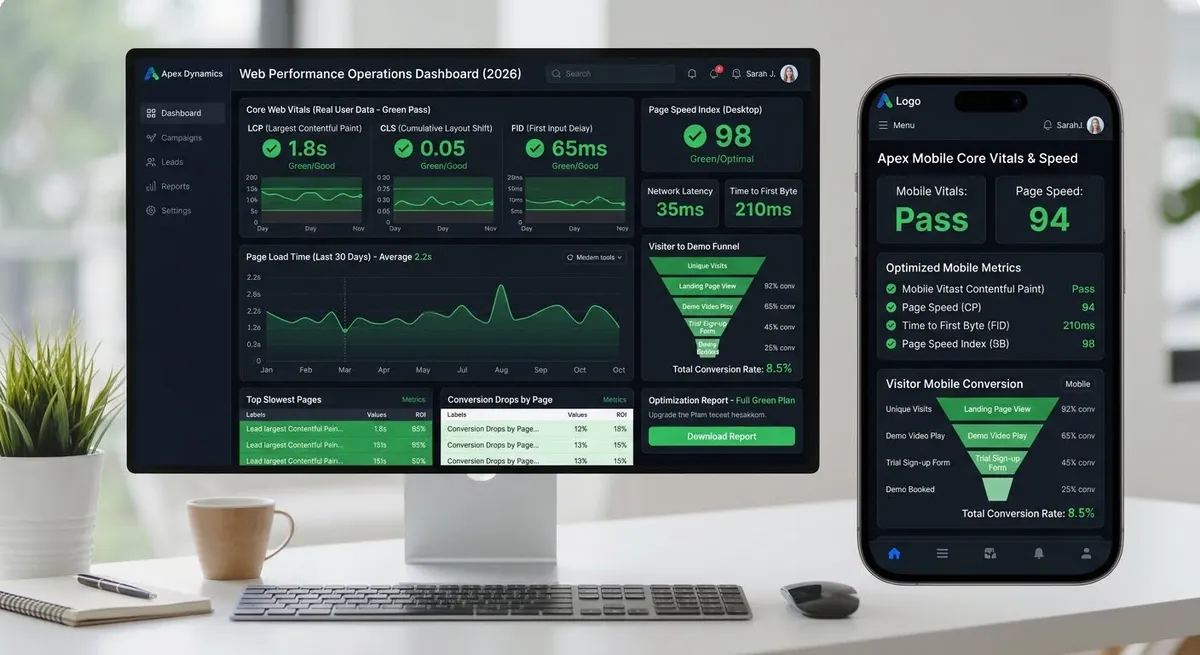
Monitor Core Web Vitals to evaluate the real-world experience of website visitors. Focus on three key metrics: Largest Contentful Paint (LCP), Interaction to Next Paint (INP), and Cumulative Layout Shift (CLS). Google’s recommended good-performance thresholds are an LCP of 2.5 seconds or less, an INP of 200 milliseconds or less, and a CLS score of 0.1 or less.
Use Google PageSpeed Insights to review performance issues and identify opportunities for improvement. Check both mobile and desktop results, since visitors may experience different loading and interaction performance across devices.
Common improvements include compressing images, using modern image formats, enabling lazy loading for below-the-fold images, reducing unnecessary scripts, and using a content delivery network (CDN). Recheck performance after making changes to evaluate whether the improvements have helped.
SEO-Friendly Architecture
Ensure your B2B SaaS website supports search visibility through a clear site structure, descriptive heading tags, optimized meta descriptions, and relevant internal links. Use appropriate structured data, such as Article schema for blog content, to help search engines understand the page. Validate your structured data before implementation and avoid adding markup that does not accurately reflect the visible content. Learn more about avoiding SEO mistakes in web design that kill rankings and revenue.
Accessibility and Compliance
Accessibility is an important part of creating an inclusive B2B SaaS website experience. Follow the Web Content Accessibility Guidelines (WCAG) 2.2 to help make website content usable for people with different abilities.
Use sufficient color contrast between text and backgrounds, provide descriptive alternative text for meaningful images, and ensure that visitors can navigate interactive elements using a keyboard. Use clear labels for form fields, descriptive link text, and visible focus indicators so users can understand and interact with each page.
Test important website functions with keyboard navigation and screen reader tools. Regular accessibility reviews can help identify usability barriers and guide improvements as the website evolves.
Real-World Examples: What High-Converting SaaS Websites Get Right
Examining successful B2B SaaS web design implementations reveals common patterns. Leading platforms typically share these characteristics: clear value propositions, minimal distractions, strong trust signals, transparent pricing, and frictionless sign-up flows.
Websites from companies like Slack, Notion, and Figma offer useful examples of different approaches to SaaS messaging, visual design, and product presentation. Each uses a different design aesthetic but shares the same core principle: every element serves conversion, clarity, or trust-building.
Competitor Website Analysis
Reviewing competitor websites can reveal opportunities to improve your own B2B SaaS website design. Examine how competing companies communicate their value propositions, organize product information, present pricing, and encourage visitors to request demos or start free trials.
Pay attention to navigation, page structure, mobile usability, customer testimonials, and product demonstrations. Identify features that make competitor websites easier to understand and areas where their messaging may be unclear.
Use these observations to identify opportunities for differentiation. Rather than copying competitor designs, focus on communicating your product’s unique value and creating a more useful experience for your target audience.
Measuring Success: Key Metrics for B2B SaaS Web Design Performance
Design improvements only matter if they measurably impact business outcomes. Track these KPIs to evaluate your SaaS website design effectiveness:
- Free trial sign-up rate: Monitor the percentage of website visitors who start a free trial and compare results over time.
- Feature discovery rate: Track the percentage of trial users who explore key product features.
- Cost per qualified lead: Compare organic and paid acquisition to understand how website design may influence lead generation.
- Bounce rate by page: Review high bounce rates on product pages to identify possible messaging or design issues.
- Time-on-page and engagement: Review time spent on key pages alongside engagement events, such as CTA clicks, pricing page visits, and demo requests.
- Demo request conversion: Track how many prospects move from browsing the website to speaking with the sales team.
Use A/B testing systematically to optimize each section. Test headline variations, CTA button colors and copy, form field counts, and pricing display formats. Even small improvements compound into significant conversion gains over time.
Future-Proofing Your B2B SaaS Web Design Strategy
Design trends evolve, but foundational principles remain. As AI personalization, voice interfaces, and predictive UX advance, your SaaS website design must remain flexible and data-driven.
AI-Driven Personalization and Dynamic Content
AI-driven personalization can help B2B SaaS websites deliver more relevant experiences based on visitor interests, browsing behavior, and business needs. For example, a website may highlight different product benefits for visitors exploring enterprise solutions compared with those researching plans for smaller teams.
Dynamic content can also help tailor landing page messages, product recommendations, and calls to action to different audience segments. However, personalization should support the visitor’s decision-making rather than overwhelm them with unnecessary changes.
Use reliable data, respect visitor privacy, and provide clear information about data collection. Review engagement and conversion metrics to determine whether personalized experiences are genuinely improving the user journey.
Investing in a design system ensures consistency across your website and product. This improves the user experience and can reduce development costs for future updates. Consider exploring how to hire a web design agency with a complete RFP guide if you need external expertise to implement these trends.
Conclusion: Converting Prospects Into Customers Through Intentional Design
The best B2B SaaS web design is invisible; it guides users seamlessly toward conversion without friction or confusion. In 2026, success requires combining aesthetic polish with psychological insight, data-driven optimization, and unwavering focus on user outcomes.
By implementing the strategies outlined in this guide, including clear messaging, trust signals, intuitive navigation, transparent pricing, and mobile-first architecture, you’ll create a website that looks professional and supports business growth.
Ready to transform your SaaS website into a conversion engine? Contact Particular Angles today to discuss how our team can audit your current design, identify optimization opportunities, and implement proven strategies that turn visitors into customers.
The Particular Angles team combines design expertise with data-driven strategies to help businesses improve website usability, generate qualified leads, and support customer acquisition.